Best Espresso Scales (2026): Ranked by What Fits Under the Group Head
Every scale review ranks on features. The spec that actually decides whether a scale works on your machine is its height, and almost nobody publishes the number you need to compare it against. Here is that number, and the field ranked against it.
Some links below are affiliate links. If you buy through them, BrewTested may earn a small commission at no extra cost to you. We only recommend gear that passes our Fit Analysis, and we publish the ones that don't.
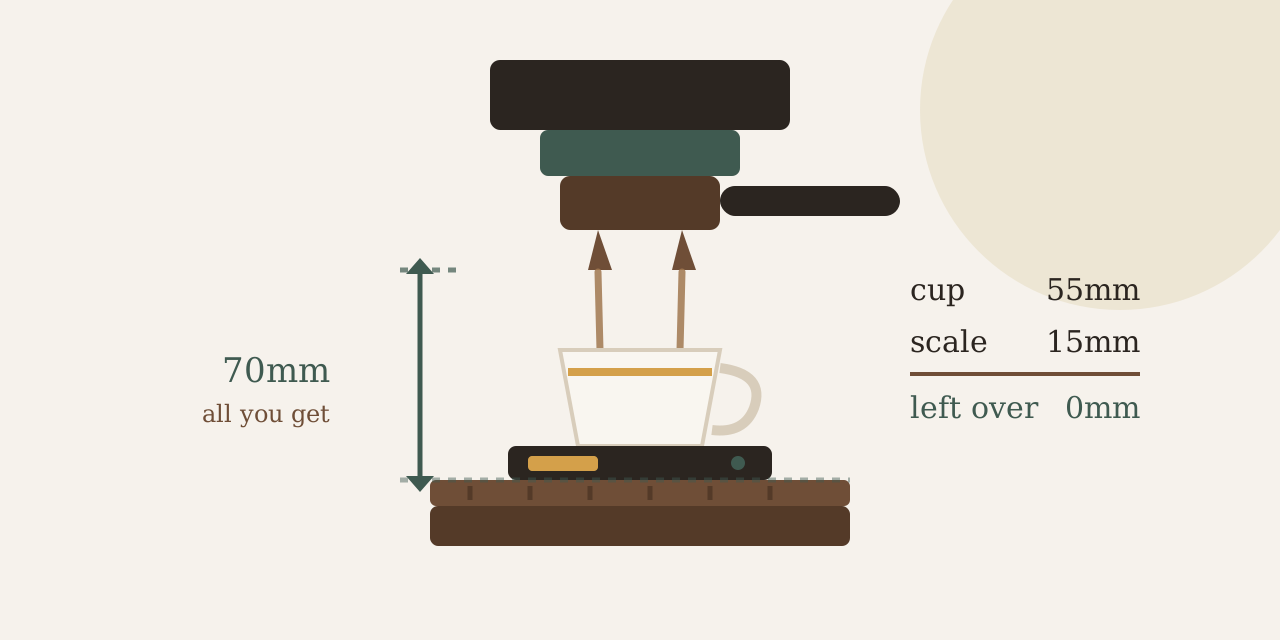
Start with your machine, not the scale. A stock Gaggia Classic Pro gives you roughly 70mm from drip tray to the spouts of a double portafilter, and roughly 95mm to the bottom of a bottomless one. That single number is your entire budget, and it has to cover the scale plus the cup plus a finger of margin.
Run the math and something awkward falls out. Acaia's own compatibility test is that a scale must fit under an engaged portafilter with a standard 60mm cappuccino cup on top. On a stock Classic Pro with a spouted portafilter, no scale on this page passes that test, because 70mm minus even the slimmest scale leaves you under 60mm. The scale is not the problem. The drip tray is.
So the ranking below is by fit first:
- BOOKOO Themis Mini, 80 x 80 x 15mm and 140g. The smallest footprint and joint-slimmest profile in the category, which makes it the default for a tight machine.
- Acaia Lunar, 105 x 105 x 15.5mm. Equally slim but a much bigger footprint, and the reference product the whole category is measured against.
- BOOKOO Themis Ultra, the IP67 one. Buy it for the sealing and the sub-100ms response rather than the size.
- Timemore Black Mirror Nano, around 20mm tall. The 5mm it gives away matters more than it sounds like it should.
Method note, stated plainly: BrewTested has not bench-tested these scales. Dimensions and ratings below are manufacturer specifications, and the clearance figures are published measurements for the machines named. Our standards are in how we test.
The spec that decides everything, and why no listing publishes it
Espresso scale listings compete on features: flow rate display, auto tare, auto start, app connectivity, extraction curves. All of that is real, and none of it matters if the scale does not physically fit under your group head with a cup on it.
Fit is a subtraction problem with three terms:
Clearance is what your machine gives you, measured from the drip tray surface to the lowest point of an engaged portafilter. On a stock Gaggia Classic Pro that is about 70mm with a standard double spout, and about 95mm with a bottomless portafilter, because a bottomless has no spouts hanging down.
Scale height is what you spend. The slim end of the category sits at 15 to 15.5mm. The middle sits around 20mm.
Cup height is what is left. A 60mm cappuccino cup is Acaia's own benchmark. A typical 2 to 3oz espresso cup is more like 55 to 65mm. A shot glass can be under 50mm.
So on a stock Classic Pro with a spouted portafilter: 70 minus 15 leaves 55mm of cup. That rules out a cappuccino cup and most espresso cups, and leaves you pulling into a shot glass or a low tumbler. Swap to a bottomless portafilter and the same scale leaves 80mm, which comfortably clears a cappuccino cup.
The useful conclusion is not "buy the slimmest scale". It is that 5mm of scale height is worth much less than a portafilter swap or a slim drip tray, and both of those are cheaper than the difference between scales. Slim replacement drip trays for this machine are commonly around 25mm tall and buy back roughly that much clearance, and lower drip tray kits are sold specifically to get total clearance under the spouts to around 100mm.
If your machine is a Breville Barista Express or Bambino class unit, the same arithmetic applies with different numbers. Measure yours before you buy anything.
Measure your own machine in two minutes
Do this before you read the rest of this page. It converts every recommendation here into a yes or a no.
- Lock your portafilter into the group as if you were pulling a shot.
- Stand a ruler on the drip tray grate, next to the portafilter, not under it.
- Read the height at the lowest point of the portafilter. For a spouted basket that is the tip of the spouts. For a bottomless it is the underside of the basket.
- Subtract the height of the cup you actually use. Measure it, do not guess, because cup heights vary far more than people expect.
What is left is your scale budget. If it is under about 15mm, no scale in this category fits and your fix is a drip tray or a portafilter, not a purchase from this page. If it is 15 to 20mm, buy from the slim tier below. If it is over 25mm, fit is not your constraint and you can choose on features like everyone else.
One more measurement worth taking: the width and depth of the flat area of your drip tray. A scale that is technically short enough but overhangs the tray will sit on an edge, rock, and give you unstable readings. This is the complaint behind the 3D printed drip tray covers people make specifically to stop a scale sliding around.
The field, ranked by fit
| Scale | Height | Footprint | Capacity / resolution | Sealing | Cup left on a stock Classic Pro (spouted) |
|---|---|---|---|---|---|
| BOOKOO Themis Mini | 15mm | 80 x 80mm, 140g | 1000g / 0.1g | IPX4 cover | ~55mm |
| Acaia Lunar | 15.5mm | 105 x 105mm, 270g | 2000g / 0.1g | Water-resistant anodized body | ~54mm |
| BOOKOO Themis Ultra | Not published as a single figure | Larger than the Mini | 2000g / 0.1g | IP67, fully sealed | Measure before buying |
| Timemore Black Mirror Nano | ~20mm | ~100 x 115mm | 2000g / 0.1g | Silicone cover, not sealed | ~50mm |
BOOKOO Themis Mini: the one to buy for a tight machine
At 80 x 80 x 15mm and 140g, this is the smallest package in the category on both axes that matter. The footprint is the quiet advantage: 80mm square sits inside the flat area of almost any drip tray, which is what stops the rocking and the unstable zero that people blame on the scale's sensor.
The published specification is 1000g capacity at 0.1g resolution, a 0.1g/s flow rate readout, a 500mAh cell rated for around 24 hours of use, and an IPX4 water-resistant cover. Read that IPX4 carefully, because BOOKOO's own documentation is unusually honest about it: the surface resists splashes, and it is explicitly not built for hot steam, temperature shock, or being rinsed under a tap. That is the correct expectation for a scale living in a drip tray.
The 1000g capacity is the one real limitation. It is plenty for a cup and a shot. It is not enough to weigh a full bag of beans plus a container, so if you wanted one scale for both dosing and brewing, this is the wrong one.
Buy it if your clearance is tight, your drip tray is small, or you want the least intrusive thing that does the job.
Acaia Lunar: the reference, and the footprint problem
The Lunar is the scale every other scale is compared against, and it earns that on responsiveness, build and software. At 105 x 105 x 15.5mm it is essentially as slim as the Themis Mini, so on pure height it fits anywhere the Mini fits.
The difference is the footprint. 105mm square is a third wider in each direction, and on a small drip tray that is the difference between sitting flat and sitting on the edge. Acaia publishes its own compatibility guidance for exactly this reason, and its stated test is whether the scale fits under an engaged portafilter with a 60mm cappuccino cup on top. It is worth knowing that this is a machine test as much as a scale test.
The body is anodized aluminium with water-resistant construction, 2000g capacity at 0.1g, and it is the most expensive option here by a wide margin, commonly around $250 as of mid-2026.
Buy it if you have the drip tray real estate and you want the responsiveness and the ecosystem. Do not buy it on the assumption that price solves fit. On a small machine the cheaper scale is the better fit.
BOOKOO Themis Ultra: buy this one for the sealing
The Ultra is the answer to the failure mode that actually kills espresso scales, which is not being dropped. It is living in a wet drip tray, catching steam wand purges and portafilter drips, week after week.
Its headline is IP67, meaning fully sealed rather than splash resistant, in a body of abrasion-resistant plastic with a steel base plate and food-grade silicone. Published specs are 2000g at 0.1g, sub-100ms response, and a 2000mAh cell quoted at up to 72 hours of continuous use. It also talks to Decent, Gaggiuino and Odyssey setups and supports auto-stop at a target yield, which is the feature that matters if you are chasing a repeatable ratio rather than watching a number.
The caveat is the one this article exists for: BOOKOO does not publish a single clean height figure for the Ultra the way it does for the Mini, and it is visibly the larger of the two. Measure your clearance first and treat the Ultra as the pick for machines with room, not as a straight upgrade from the Mini.
Buy it if your scale keeps dying wet, you run a machine with clearance to spare, or you want extraction curves without modifying the machine.
Timemore Black Mirror Nano: good scale, 5mm too tall
The Nano is a genuinely good scale and a regular recommendation, with 2000g capacity at 0.1g, flow rate display and auto timing, usually at a fraction of Lunar money.
At roughly 100 x 115 x 20mm it is the tallest of the four here, and on a tight machine that 5mm is the difference between a cup fitting and not. Owners of small machines report exactly this: it goes under a naked portafilter, and only the smallest cups fit on top. Its silicone cover is a cover, not a seal.
Buy it if you measured and you have the room, or if the scale will mostly live on the counter for pour over with occasional espresso duty. Skip it if your clearance measurement came in under about 75mm.
What to ignore while you are shopping
Advertised accuracy claims below 0.1g. Every scale here reads to 0.1g, which is finer than the repeatability of your dosing, your distribution and your grinder's retention. Nobody's espresso is limited by the fourth significant figure.
Capacity above 2000g. For espresso you are weighing a cup and a shot, and the cup is the heavy part. 1000g is enough unless you want one scale for weighing bean bags too.
Bluetooth, unless you will actually use it. App connectivity earns its keep if you want extraction curves or you run Gaggiuino or a Decent. If you are going to look at the number on the scale and then drink the coffee, it is a battery drain and another thing to pair.
Battery life comparisons. The quoted figures here range from around 24 to 72 hours of continuous use, which in practice is weeks to months of real brewing for anyone. All of them are fine.
What is worth paying for, in order: fit, then stability of the reading, then water resistance, then response time. Everything after that is preference.
Transparency: BrewTested has not put these scales on our own bench, and this page will be updated when our ownership logs cover them. Dimensions, capacities, sealing ratings and battery figures above are manufacturer specifications. The 70mm and 95mm Gaggia Classic Pro clearance figures and the roughly 25mm slim drip tray height are published measurements from retailers and parts suppliers for that machine, not our own. Prices are hedged as of mid-2026. Measure your own machine before buying, because that is the only number that decides this. As an Amazon Associate, BrewTested earns from qualifying purchases.
Espresso scales: FAQ
What is the best espresso scale that fits under a Gaggia Classic Pro?
On fit alone, the BOOKOO Themis Mini, because 80 x 80 x 15mm is the smallest package in the category and the small footprint sits inside the drip tray rather than on its edges. The Acaia Lunar is equally slim at 15.5mm but 105mm square, which overhangs a small tray. Either way, a stock Classic Pro gives you about 70mm to a spouted portafilter, so after the scale you have around 55mm of cup height. If you want a normal cup, change the drip tray or fit a bottomless portafilter rather than shopping for a thinner scale.
How much clearance do I need for an espresso scale?
Add your scale height and your cup height, then add 5mm so you can actually lift the cup out. Slim scales are 15 to 15.5mm, mid ones around 20mm, and espresso cups run roughly 50 to 65mm. So you need somewhere between 70mm and 90mm of drip tray to portafilter clearance for a comfortable setup. Measure with the portafilter locked in, using a ruler stood beside it, because published machine specs almost never state this number.
Does an espresso scale need to be waterproof?
It needs to survive splashes, and the difference between ratings is worth understanding. IPX4 means splash resistant, which is the common rating and is adequate for a scale that lives in a drip tray and gets wiped. IP67 means fully sealed and is the tier that survives being rinsed. Manufacturers of splash-resistant scales are usually explicit that hot steam and temperature shock are not covered, and steam is the thing most likely to kill a scale in daily use.
Is an Acaia Lunar worth it over a $60 scale?
For responsiveness, build quality and software, it is a genuinely better instrument, and it is priced accordingly at around $250 as of mid-2026. For fit, it is not an upgrade: it is 0.5mm taller than the Themis Mini and considerably wider, so on a small machine the cheap scale is the one that works. Buy the Lunar because you want the instrument, not because you assume the expensive one solves a clearance problem.
Why does my scale give unstable readings during a shot?
Usually placement rather than the sensor. A scale that overhangs the flat area of the drip tray rests on an edge or on the grate ribs and rocks, which is enough to make the reading wander and the tare unreliable. This is the exact problem people solve with flat drip tray covers. Check that the whole base is supported on a flat surface, that nothing is touching the scale from the side, and that the portafilter is not dripping directly onto the display.
Related reading
A scale is the second measurement tool in an espresso setup, and the first is the grinder. If you are still assembling the kit, how to split your espresso budget covers where a scale sits in the order of spending, and best espresso grinders under $500 covers the purchase that changes the cup most. If your shots are inconsistent and you are hoping a scale fixes it, the diagnosis is in why your espresso tastes sour or bitter, and weighing the dose and the yield is step one of that ladder. For Gaggia Classic Pro owners specifically, the drip tray and portafilter changes discussed above sit alongside the rest of the upgrade path in Gaggia Classic Pro mods.