How to Split an Espresso Budget: $600, $1,200 and $2,000
Not which machine to buy. How to divide the money across machine, grinder and the kit nobody budgets for, at three real totals, and where the extra money genuinely stops paying you back.
Some links below are affiliate links. If you buy through them, BrewTested may earn a small commission at no extra cost to you. We only recommend gear that passes our Fit Analysis, and we publish the ones that don't.
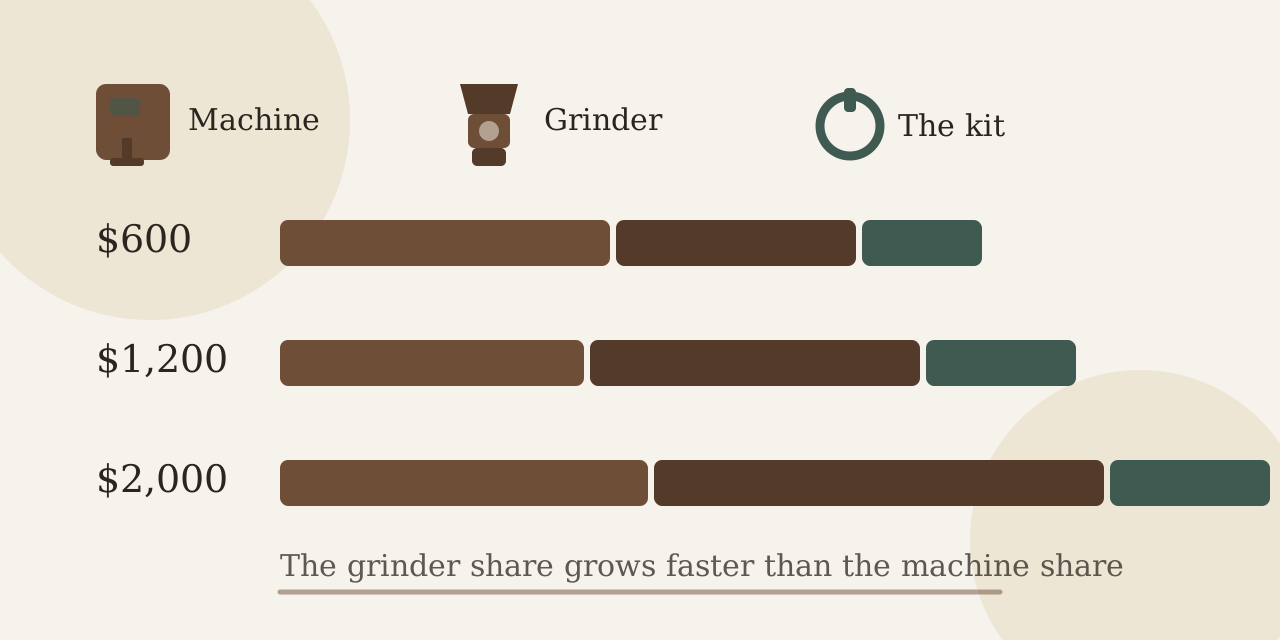
The allocation matters more than the products. At every budget on this page the same mistake costs people the most cup quality: they spend nearly all of it on the machine, add whatever grinder is left over, and budget nothing for the kit that makes a shot repeatable. A setup where the grinder takes a third to a half of the money and about $150 is reserved for accessories will beat a setup at the same total that put everything into a shinier boiler.
The three splits, roughly. At $600 you are buying a capable entry machine and accepting a hand grinder — that is the honest trade, and it is a good one. At $1,200 you get a competent electric grinder alongside the same class of machine, and this is where most people should stop. At $2,000 the extra money buys a better grinder first and a machine with real temperature control second.
Where the money stops working. Published guidance across the hobby converges on the same shape: the dual-boiler tier at roughly $2,000 to $3,500 is where most people stop unless they are chasing something specific, and beyond about $5,000 you are largely buying build quality, ergonomics and looks rather than a better shot. If you are staring at a $3,000 to $5,000 machine and struggling to name what you would gain in the cup, that instinct is well founded.
This guide is about allocation. For the argument about *why* the grinder outranks the machine, we wrote that separately in grinder first or machine first and will not repeat it here.

The three things a budget has to cover
Almost every "what should I buy for $X" answer is really a list of two products. A working espresso setup is three, and the third one is where budgets quietly fail.
The machine puts hot water through coffee at pressure. Above the very bottom of the market, most of them do this adequately. What separates them is temperature stability, steam power, and whether they give you any control over the shot.
The grinder decides how the water moves through the coffee, which is the single largest lever on how the shot tastes. This is not controversial in the hobby and it is why the doctrine exists.
The kit is a 0.1g scale with a timer, a distribution tool, a decent basket, and a way to see what your puck is doing. It costs somewhere around $100 to $150 in total and it is the part people cut when the machine they wanted went up in price. That is backwards. Without a scale you cannot repeat a shot, and a setup you cannot repeat is a setup you cannot improve.
So the allocation question is not "machine or grinder". It is: what fraction of the total goes to each of three things, and what does that fraction buy at this budget.
The three splits at a glance
| Total | Machine | Grinder | The kit | The honest trade |
|---|---|---|---|---|
| ~$600 | Bambino, around $300 list | Hand grinder: Kingrinder K6 or 1Zpresso J-Max | ~$100 — scale and a WDT tool | You crank every dose by hand. Everything else is genuinely good. |
| ~$1,200 | Bambino Plus or Gaggia Classic Evo Pro, around $500 | DF54 (verified $229) or DF64 Gen 2 (verified $389) | ~$150 — scale, WDT, IMS basket, bottomless portafilter | Very little. This is the value peak of the whole category. |
| ~$2,000 | Barista Pro (verified $835) or Rancilio Silvia (verified $995) | DF64 Gen 2 or a Eureka Mignon Specialita class grinder | ~$150–200, plus water treatment | You are paying for consistency and steam, not for a different flavour ceiling. |
$600: the honest floor
Six hundred dollars buys a genuinely good setup as long as you accept one thing: the grinder is going to be manual.
The arithmetic is unavoidable. A capable entry machine like the Bambino sits around $300 at list. An electric grinder that can actually hold an espresso grind setting starts around $200 and the good ones are higher. Add the kit and you are over budget before you have bought coffee. Something has to give, and the option that costs you the least in the cup is the motor.
A Kingrinder K6 at roughly $99, or a 1Zpresso J-Max at roughly $159 to $199, grinds espresso properly. Not "acceptably for the price" — properly. Hand grinders in this class routinely out-perform electric grinders costing twice as much, because you are paying for burrs and a shaft rather than for a motor, a housing and a chute.
What you actually give up is about 45 to 60 seconds of effort per dose. That is the whole trade. For one or two drinks a morning it is nothing. For a household making six drinks before work it is the reason this tier does not scale.
Reserve about $100 regardless. A 0.1g scale with a timer and a WDT tool are not upgrades at this budget, they are what turns a $600 pile of hardware into something you can dial in. If the money is not there, buy the scale and make the WDT tool out of a cork and some acupuncture needles, which is what half the hobby did before anyone sold them.
$1,200: where most people should stop
This is the tier that works, and it works because doubling the budget from $600 does not double the machine. It buys the motor back.
The machine barely moves: a Bambino Plus at around $500 list adds automatic milk texturing, or a Gaggia Classic Evo Pro at around $499 gives you a commercial 58mm portafilter and a deep modification path. Both are the same class of shot as the $300 machine below them.
The grinder is where the extra money goes, and it is a real step. A DF54, verified at $229 in early August 2026, or a DF64 Gen 2 at $389, gives you single-dosing, flat burrs, and enough adjustment resolution to actually chase a shot. A Baratza Encore ESP at around $200 is the conservative alternative with the better support story.
And this time the kit fits comfortably. Roughly $150 covers a scale, a WDT tool, an IMS precision basket and, on the Gaggia, a bottomless portafilter that shows you exactly where your puck prep is failing.
Why stop here. The next thousand dollars buys temperature stability and steam capacity. Those are real and they matter if you make several milk drinks back to back or you are chasing a specific light-roast profile. They are not a new flavour ceiling. Someone who dials in carefully on a $1,200 setup will out-brew someone who does not on a $3,000 one, and that is not a motivational slogan, it is what the variables are worth.
$2,000: what the extra $800 actually buys
Two thousand dollars is where the question changes from "what can I afford" to "what am I actually buying". The answer is consistency, not a higher peak.
Spend it on the grinder first, again. The pattern that holds across the hobby is that the single most obvious jump in the cup comes from moving up a grinder class, not a machine class. If your $2,000 is going to be split unevenly, the uneven side should be the grinder — a DF64 Gen 2 or a Eureka Mignon Specialita-class grinder is a meaningfully different tool from a $200 one, in retention, in grind quality and in how repeatable your mornings are.
Then the machine, for three specific things. A Barista Pro, verified at $835 in early August 2026, buys a faster heat-up and an integrated grinder you may not need. A Rancilio Silvia at a verified $995 buys a commercial group and a steam wand that is genuinely a class above, at the cost of no PID unless you add one. What you are buying at this tier is temperature stability, steam power, and shot control — the machine holding still so your variables are the only ones moving.
Budget for water. At this level water chemistry stops being optional, both for taste and because scale is what kills machines in this price class. Test strips and either a filter or a mineral-packet system belong in the plan.
What $2,000 does not buy. It does not buy a different ceiling on how good a single shot can taste. Almost everything above this point — dual boilers, E61 groups, flow profiling — is buying you the ability to hit your best shot more often, faster, and for more people in a row.
"What would I actually gain in the cup?" This is the question people ask when they look at a $3,000 to $5,000 machine, and the honest answer is: less than the price gap suggests. The widely repeated shape of it in the hobby is that the $2,000 to $3,500 dual-boiler tier is where most people stop, and that past roughly $5,000 you are buying aesthetics, ergonomics and build quality rather than a better shot — the difference between a $3,500 enthusiast machine and an $8,000 prosumer one being small in the cup. If you cannot name the specific thing you want that your current setup will not do — simultaneous brew and steam, degree-level temperature targeting, back-to-back milk drinks for four people — then the upgrade you are looking for is probably a grinder, or a bag of fresher coffee.
The $150 that changes more than $500 of machine
If you take one thing from this page, take this: the accessories are not the leftovers. Ranked by how much they change the cup per dollar, they beat almost any machine upgrade at any of these budgets.
A 0.1g scale with a timer, roughly $30 to $50. Without it you are guessing dose and yield, and a shot you cannot measure is a shot you cannot repeat or diagnose. This is the highest-value object in home espresso and it costs less than a bag of good beans.
A WDT tool, roughly $15 to $30. Breaks up clumps so the water cannot find a channel. It is the cheapest fix for the single most common cause of a sour, thin, fast shot.
An IMS or similar precision basket, roughly $30 to $40. Stock baskets vary in hole size and distribution; a precision basket removes a variable you did not know you had.
A bottomless portafilter, roughly $30 to $50, on any 58mm machine. It is a diagnostic instrument. You cannot fix channelling you cannot see.
That is the ladder, in order, and it is the same one we walk through in why your espresso tastes sour or bitter. Work it before you spend another dollar on a boiler.
Where to spend your next dollar
Wherever you are now, the order of operations is the same and it rarely starts with a machine:
- No scale? Buy the scale. Nothing else you could spend $40 on comes close.
- Machine you like, grinder under $150 electric? The grinder. This is the biggest single available jump.
- Good grinder, no bottomless portafilter, 58mm machine? The portafilter, then fix what it shows you.
- All of the above sorted and shots still inconsistent? Water, then coffee freshness, then technique — in that order, and all three are cheaper than a machine.
- All of that sorted and you make four milk drinks back to back every morning? Now a machine upgrade is buying you something real. Steam capacity and recovery time are the specs to read.
- All of that sorted and you just want a nicer object? That is a legitimate reason to spend money. It is just not a cup-quality reason, and it is worth being honest with yourself about which one you are buying.
Splitting an espresso budget: FAQ
How should I split a $1,000 espresso budget?
Roughly $400 to $500 on the machine, $350 to $400 on the grinder, and $150 held back for a scale, a WDT tool and a decent basket. That lands you very close to the $1,200 tier on this page and it is the split with the best return in the category. The version that goes wrong is $800 on the machine and $200 on whatever grinder is left, which produces a setup that looks better than it tastes.
Is a $2,000 espresso setup worth it over a $1,200 one?
Only for specific reasons, and they are worth naming before you spend. The extra money buys temperature stability, more steam capacity for back-to-back milk drinks, and a grinder class up. It does not raise the ceiling on how good one carefully dialled shot can taste. If you make one or two drinks a morning and you are still learning your variables, the $1,200 tier plus better coffee will serve you better.
Should I spend more on the grinder or the machine?
The grinder, at every budget on this page, and by a wider margin at the lower end. The full argument, including what "espresso-capable" actually means in a grinder spec, is in our separate guide on grinder first or machine first. The short version is that grind quality and adjustment resolution move the cup more than anything the machine does, once the machine can hold pressure and temperature at all.
Can you make good espresso for under $600?
Yes, provided you accept a hand grinder. A capable entry machine around $300 plus a $99 to $199 hand grinder plus a scale is a genuinely good setup, and hand grinders in that price range regularly beat electrics at twice the money because you are paying for burrs rather than a motor. The cost is 45 to 60 seconds of cranking per dose, which is fine for one or two drinks and painful for six.
What accessories do I actually need to start?
A 0.1g scale with a timer, and a distribution tool. That is the genuine minimum, and together they are usually under $80. A precision basket and a bottomless portafilter come next and are diagnostic as much as they are upgrades. Everything beyond that — tamping stations, puck screens, dosing funnels — is refinement rather than requirement.
At what price do espresso machines stop getting better?
The commonly cited shape is that the dual-boiler tier around $2,000 to $3,500 is where most home setups stop, and that past roughly $5,000 the money goes into build quality, ergonomics and appearance rather than the cup. That is a synthesis of what the hobby broadly reports rather than a measured finding. The practical test is simpler: if you cannot name the capability you are buying, you are buying an object rather than a better shot.
Where this guide comes from: BrewTested has not bench-tested these machines and grinders. The allocation logic synthesizes manufacturer list pricing, community consensus on r/espresso and Home-Barista, and published buying guidance; where a figure is consensus rather than measurement we have said so. Prices marked "verified" were checked against live Amazon listings on 2026-08-03 and everything else is list price or a typical street range — all of it moves, so check the current price at each link before you plan around it. Standards at how we test.
Related reading
The doctrine behind all of this is in grinder first or machine first. For the products themselves, the machine tiers are covered in best espresso machine under $500 and best espresso machine under $1,000, and the grinders in best espresso grinder under $500 and the best espresso grinder under $200. If your current setup is the problem rather than your budget, start with why your espresso tastes sour or bitter — the fix ladder there is cheaper than any tier on this page. And if the appeal of all this is the button rather than the process, read should you buy a super-automatic before you spend a cent here.