Best Espresso Machines Under $1,000 (2026)
A thousand dollars is the first budget that can buy a good machine and a good grinder at the same time. That single fact reshuffles the whole field, and it is why the most-bought machine in this tier is not the one we would buy.
Some links below are affiliate links. If you buy through them, BrewTested may earn a small commission at no extra cost to you. We only recommend gear that passes our Fit Analysis, and we publish the ones that don't.
Under $500, the grinder is the thing you cannot afford. Under $1,000, you can — and that changes the right answer, not just the price.
The best espresso per dollar is two boxes: a Breville Bambino Plus (~$400-500 street) plus a real single-dose grinder like a Turin DF64 (~$300-400) or, cheaper, a Baratza Encore ESP (~$200). Roughly $700-900 all in, and the grind quality is a tier above anything with a grinder bolted inside it.
The best one box is the Breville Barista Express (list ~$699.95, commonly $549-650 street). Machine and grinder in one footprint, one purchase, one decision. The built-in grinder is the package's weak point and it cannot be upgraded, which is the trade you are making.
The Barista Pro (list ~$849.95, street commonly $600-700) is the same idea with ThermoJet heating, a digital display, and 30 grind settings instead of 16. It is faster and nicer. Reviewers consistently report shot quality that is comparable to the Express, so treat the difference as convenience, not espresso.
To learn and tinker: a Gaggia Classic Evo Pro (~$449-499) plus a grinder, which now fits the budget comfortably with room for a better grinder than the under-$500 page could afford.
The one to skip at this price: the Rancilio Silvia (~$995). Wonderful machine, and at that price it eats the entire budget and leaves nothing for the grinder it depends on.
Method note, stated plainly: BrewTested has not bench-tested these machines. This page synthesizes manufacturer specifications, retailer pricing observed in mid-2026, and sustained owner reporting on r/espresso and Home-Barista. Prices move constantly — treat every figure as a band, not a quote. Standards we are building toward: how we test.

What $1,000 actually changes
The under-$500 page has a defining catch: every machine worth buying at that price leaves the grinder out of the box, and the grinder is not optional. Espresso is a grind-limited drink. That constraint dominates the entire tier.
At $1,000 the constraint lifts. You can spend $450-500 on a machine and still put $300-400 into a grinder that genuinely grinds espresso — stepless or fine-stepped adjustment, low retention, burrs that hold their setting. That is the first budget where a home setup stops being a compromise, and it is why the shape of the advice inverts.
Below $500, the argument for an all-in-one is strong, because a built-in grinder is often better than no grinder. Above $500, the argument weakens every dollar you go up, because the money you are handing to a built-in grinder buys a much better standalone one. Community consensus on the Breville built-in grinders is consistent and unsentimental: they work, they get you started, and they are the first component owners outgrow — with the added sting that on the Express and Pro you cannot replace the grinder without replacing the machine.
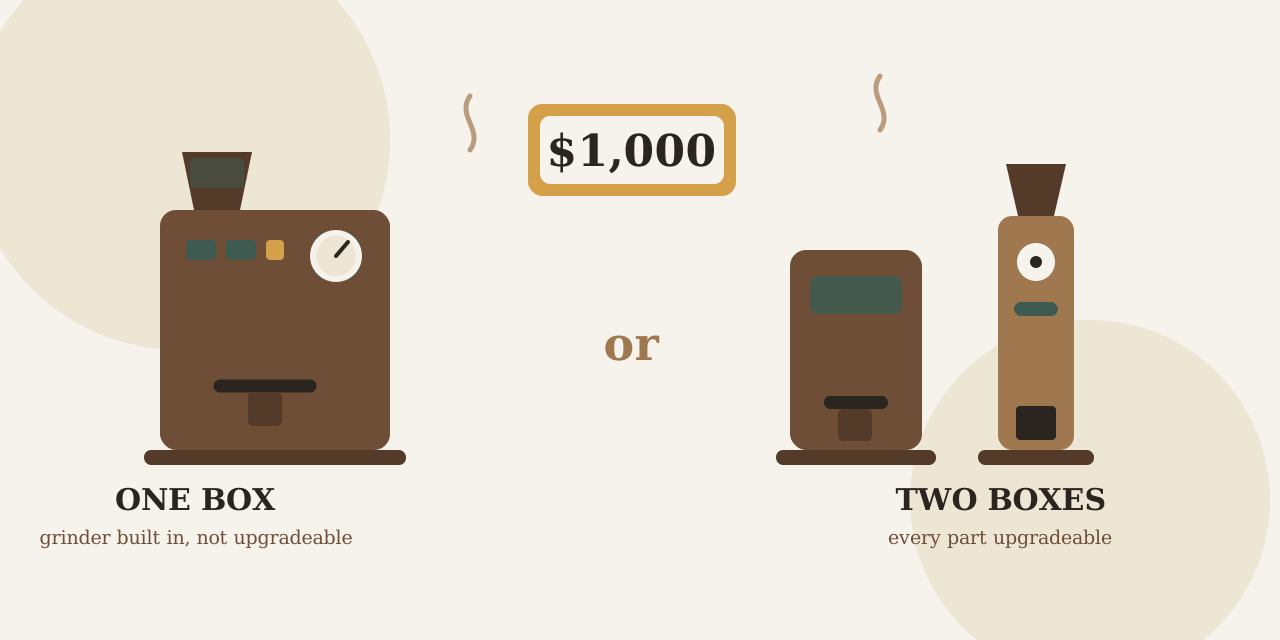
So this page is organised around one question, and it is not "which machine." It is one box or two. We laid the same argument out at street prices in Barista Express vs Bambino Plus + DF54; this page extends it to the full under-$1,000 field, and the order of purchase is covered in grinder first or machine first.
The under-$1,000 field, compared
| Setup | Type | Portafilter | Grinder | Milk / steam | Price band (2026) |
|---|---|---|---|---|---|
| Bambino Plus + DF64 | Separates: thermoblock + single-dose grinder | 54mm | Standalone, upgradeable | Automatic texturing | ~$700-900 combined |
| Breville Barista Express | All-in-one, thermocoil | 54mm | Built in, 16 settings, not upgradeable | Manual wand | ~$699.95 list, $549-650 street |
| Breville Barista Pro | All-in-one, ThermoJet | 54mm | Built in, 30 settings, not upgradeable | Manual wand | ~$849.95 list, $600-700 street |
| Gaggia Classic Evo Pro + grinder | Separates: single boiler, commercial-style | 58mm commercial | Standalone, upgradeable | Commercial wand | ~$650-900 combined |
| Lelit Anna PL41TEM | Single boiler with PID | 57mm | None | Commercial-style wand | ~$599-699, grinder extra |
| De'Longhi La Specialista Arte | All-in-one with grinder | 51mm | Built in, conical | Manual wand | ~$499-549 |
| Rancilio Silvia | Single boiler, commercial build | 58mm commercial | None | Commercial wand | ~$995, grinder extra |
The separates build: Bambino Plus and a real grinder
This is the setup we would buy with $1,000, and the reasoning is boring: it puts the money where the espresso is.
The Bambino Plus is a small thermoblock machine with automatic milk texturing — a probe reads the pitcher, and the machine steams and stops itself. It brews as well as machines that cost twice as much, heats in seconds, and takes up almost no counter. What it does not do is grind, which on this page is a feature rather than a gap: it means every dollar above the machine's price goes into a grinder you choose, and can later sell or upgrade without touching the machine.
For the grinder half, the band matters more than the model:
- Around $300-400, a single-dose flat-burr grinder like the Turin DF64 is the class of tool that makes an under-$500 machine punch far above itself. Stepless adjustment, low retention, and grind quality no built-in unit at this price approaches
- Around $200, the Baratza Encore ESP is the honest budget answer: purpose-built for espresso adjustment, serviceable, widely supported, and the pick if you would rather leave money for beans
- Under $200, a good hand grinder outperforms most cheap electrics — the full case is in our under-$200 grinder roundup
The costs of the separates route are real and worth stating. Two boxes take more counter than one wide box. The workflow has more steps: grind into a dosing cup, transfer, distribute, tamp. And there is no single warranty covering the setup. If those sound like reasons rather than details, the all-in-one section below is written for you.
One variation worth knowing: swapping the Bambino Plus for the plain Bambino saves roughly $100-150 and buys manual steaming instead of automatic. If you drink espresso and americanos rather than lattes, that is free money to move into the grinder.
Breville Barista Express: the one-box default
The Barista Express (BES870) is the best-selling all-in-one in North America and it earns that honestly. Machine, conical burr grinder, dosing and tamping station, and a manual steam wand in a single footprint, with a list price around $699.95 and street pricing that commonly lands $549-650. You unbox it, you grind straight into the portafilter, you pull a shot. Nothing else in this price range gets you from box to drinkable espresso as fast.
The brewing side is genuinely good: a 54mm portafilter, a thermocoil heating system with PID-managed temperature, and pressure that lands where espresso wants it. The workflow — grind, dose, tamp, all at the same station — is the reason people who own one keep recommending it, and there is nothing dishonest about that recommendation.
The caveat is the grinder, and it is the same caveat every time. Owner consensus rates the integrated conical burr as the weakest component in the package, with 16 grind settings that some users find limiting on lighter roasts. It is fine. It is not the grinder you would buy for $250 on its own, and unlike every other component of your setup, you cannot replace it. When you outgrow it, your options are to add an external grinder anyway — leaving you paying for a built-in you no longer use — or to sell the machine.
Buy it if you want an appliance rather than a project, if counter space is genuinely tight, or if the idea of a two-box workflow at 6am sounds like a reason to stop making espresso at home. Those are good reasons and plenty of happy owners have them. Our full ownership breakdown is in the Barista Express review, and the common faults are catalogued in Barista Express problems and solutions.
Breville Barista Pro: what the upgrade actually buys
The Barista Pro (BES878) sits above the Express — list around $849.95, street commonly $600-700 and lower on sale — and the differences are real but narrower than the price gap suggests.
What you get: ThermoJet heating, which Breville rates at roughly a 3 second heat-up against the Express's warm-up period; a digital display that shows grind size, shot time and temperature instead of the Express's analogue gauge; and 30 grind settings instead of 16, which is the most substantive of the three because it gives you finer adjustment on light roasts where the Express runs out of room.
What you do not get is better espresso. Reviewers who have used both consistently describe shot quality as comparable, because the brewing core is fundamentally the same idea. The upgrade is speed and interface.
That makes the Pro easy to place. If you find it within about $75 of the Express, take it — the faster heat-up alone changes how often you bother on a weekday morning. If the gap is $200, spend the difference on a standalone grinder instead and buy the Express, because a $200 grinder improves your espresso more than 14 extra grind settings on a built-in ever will. And if you were already leaning separates, note that Barista Pro money buys a Bambino Plus and a genuinely good grinder.
The enthusiast lane: Gaggia Classic Evo Pro and Lelit Anna
Two machines here are bought for what they let you do later.
Gaggia Classic Evo Pro, around $449-499. A small single boiler with a commercial 58mm portafilter, a three-way solenoid, rocker switches, and an aftermarket that has kept the design alive for three decades. On the under-$500 page it was the enthusiast pick you could barely afford to pair with a decent grinder. At $1,000 it is the enthusiast pick with $400 of grinder attached, which is a different and much better machine to own. The mod ladder — OPV spring, PID, better basket — is walked in full in our Gaggia Classic Pro mods guide. The honest limits stay the same: brew temperature is managed by feel without a PID, and its single boiler makes back-to-back milk drinks the slowest event on this page.
Lelit Anna PL41TEM, around $599-699. The machine people mean when they say prosumer-adjacent: a brass boiler, PID temperature control from the factory, and a commercial-style steam wand in a compact body. Where the Gaggia asks you to mod your way to temperature stability, the Anna ships with it. The trade-offs are a 57mm portafilter, which is a slightly awkward size for accessories compared with the 58mm standard, and a support ecosystem thinner than either Breville's or Gaggia's in North America. Worth a serious look if PID from the box matters to you and you have grinder budget left.
Both are machine-only. Budget the grinder before you compare them to anything with one built in.
The edges of the tier: the Arte below it, the Silvia above
De'Longhi La Specialista Arte (EC9155), around $499-549. On the under-$500 page this machine was the one-box answer that just missed the line; at 2026 street pricing it now generally fits under it, which makes it the cheapest true all-in-one on this page worth recommending. Integrated conical burr grinder, a dosing and tamping station, non-pressurized baskets in the box, and a manual wand. Its portafilter is 51mm, smaller than both the Breville 54mm and the commercial 58mm, which narrows accessory options. If a single box with a grinder is a hard requirement and you want to spend the least to get it, this is the machine — and the leftover $450 buys a standalone grinder later, when the built-in stops being enough.
Rancilio Silvia, around $995. A brass single boiler, a commercial 58mm saturated group, and a body built like restaurant equipment. It is a superb machine and it is the wrong buy at this budget, for one arithmetic reason: at $995 with no grinder, it consumes the entire $1,000 and leaves you pairing a machine built for a lifetime with whatever grinder you already own. Every argument this site makes about grind quality says that is backwards. The Silvia is a machine to buy at $1,400 all-in, not at $1,000 machine-only. If it is the machine you want, wait a paycheck and buy it properly.
What to skip. The same warning as the tier below still applies at this price: any machine leaning on pressurized dual-wall baskets is generating crema through a valve rather than through extraction, and it caps your ceiling permanently no matter what grinder you pair with it. At $1,000 there is no reason to be anywhere near that tier.
Transparency: BrewTested has not run these machines on our own bench, and this page will be revised as our ownership logs come online. Everything above is drawn from manufacturer specifications (Breville, Gaggia, Lelit, Rancilio, De’Longhi), retailer pricing observed in mid-2026, and sustained owner reporting on r/espresso and Home-Barista. Price bands move with sale cycles and are hedged deliberately; check the current price at any link before buying. As an Amazon Associate, BrewTested earns from qualifying purchases.
Pick this if: the verdicts
Buy the Bambino Plus + a $300-400 grinder (~$700-900) if you want the best espresso this budget can produce and you accept two boxes on the counter. Our pick. Every part is upgradeable, and the grinder is doing the work that actually shows up in the cup.
Buy the Barista Express (~$549-650) if you want one box, one warranty, and the shortest possible workflow, and you are honest with yourself that you will not tinker. The built-in grinder is the ceiling you are accepting, and for a lot of people it is a perfectly comfortable ceiling.
Buy the Barista Pro (~$600-700) if you find it close to Express pricing. ThermoJet heat-up and 30 grind settings are worth a small premium and not a large one, because the espresso itself is not better.
Buy the Gaggia Classic Evo Pro (~$449-499) + a grinder if the mod list reads like a plan rather than a chore. At this budget it is finally paired with a grinder worthy of it.
Buy the Lelit Anna (~$599-699) if you want factory PID temperature stability without modding, and you can live with a 57mm portafilter.
Buy the La Specialista Arte (~$499-549) if a built-in grinder is non-negotiable and you want to spend the least to get one that is not faking crema.
Do not buy the Rancilio Silvia at $995 unless your grinder is already handled. It is the right machine at the wrong budget.
And once the gear lands, remember that most bad shots are dial-in rather than hardware: start with sour vs bitter, and keep the machine alive with the descaling schedule.
Best espresso machine under $1,000: FAQ
What is the best espresso machine under $1,000?
For the best espresso, a Breville Bambino Plus paired with a $300-400 single-dose grinder, around $700-900 combined — the grind quality is a clear tier above anything with a grinder built in at this price. For the best single box, the Breville Barista Express (list around $699.95, commonly $549-650 street) includes a grinder and gets you brewing fastest, at the cost of a grinder you cannot upgrade.
Is the Barista Pro worth the extra over the Barista Express?
Only if the price gap is small. The Pro adds ThermoJet heating (Breville rates it at roughly a 3 second heat-up), a digital display, and 30 grind settings against the Express’s 16. Reviewers who have used both describe shot quality as comparable, so you are buying speed and interface. Within about $75 it is an easy yes; at a $200 gap, buy the Express and put the difference into a standalone grinder.
Should I buy an all-in-one or a separate machine and grinder?
Under $500 the all-in-one argument is strong, because a built-in grinder beats no grinder. By $1,000 it has weakened considerably: that budget covers a good machine and a good standalone grinder, and the standalone will out-grind any built-in in the range. Buy the all-in-one if counter space or workflow simplicity genuinely matters more to you than the ceiling; buy separates if you suspect espresso is becoming a hobby.
Is the Rancilio Silvia a good buy at under $1,000?
It is an excellent machine and a poor fit for this budget. At roughly $995 with no grinder it uses the entire $1,000, which means pairing a machine built to last decades with whatever grinder you already have. Since grind quality limits espresso more than machine quality does at this level, that is the wrong order. Buy the Silvia when you can spend around $1,400 all-in.
How much of a $1,000 budget should go to the grinder?
Roughly a third to a half is the split that community doctrine has settled on, and this tier is the first where it is comfortably affordable: about $450-500 on the machine and $300-400 on the grinder. If you are choosing between a nicer machine and a nicer grinder with the same money, the grinder is the one that shows up in the cup.
Do any machines under $1,000 come with a grinder?
Yes, several. The Breville Barista Express and Barista Pro both integrate a conical burr grinder, and the De'Longhi La Specialista Arte does at a lower price. All three grinders are non-upgradeable, which is the trade-off. Machines in this range that do not include one — Gaggia Classic Evo Pro, Lelit Anna, Rancilio Silvia, and the Bambino family — expect you to budget for it separately.