How Often Should You Descale Your Espresso Machine? The Per-Machine Schedule (2026)
Scale is the number one killer of home espresso machines, and the right descaling interval depends on your water, not the calendar. The schedules, the chemistry, and the $10 of prevention that beats all of it.
Some links below are affiliate links. If you buy through them, BrewTested may earn a small commission at no extra cost to you. We only recommend gear that passes our Fit Analysis, and we publish the ones that don't.
There is no single right descaling interval, because the variable that matters is your water, not your machine. The honest short answers:
- Hard tap water (common across much of the US): descale every 60-90 days on Breville thermoblock machines, and roughly monthly to every other month on small-boiler machines like the Gaggia Classic
- Moderately soft or filter-pitcher water: every 3-4 months is the typical owner norm
- Low-mineral water strategies (Third Wave Water on distilled, or verified soft water): descaling becomes a once-or-twice-a-year formality, and this is the strategy that actually protects the machine
Step zero is knowing your water: a $10 pack of hardness test strips ends the guessing, and Breville machines ship with a test strip and a hardness setting for exactly this reason.
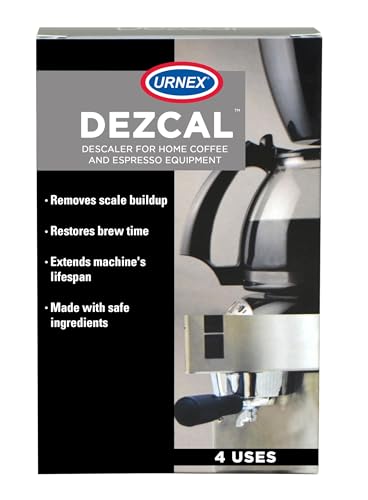
Use citric acid or a purpose-made descaler like Urnex Dezcal or Breville's own packets. Never vinegar; Breville explicitly advises against it, and it is both weaker on scale and hard on seals and boiler metals.
Why care at all: scale insulates heating elements until they overheat, kills machines through one-shot thermal fuses, and clogs solenoid valves. Most dead Brevilles in owner threads did not wear out; they scaled up. This guide is built from manufacturer guidance and owner consensus; BrewTested's own long-term logs are just starting.
Why scale kills machines (the mechanism, not the scare story)
Tap water carries dissolved calcium and magnesium. Heat water and those minerals precipitate out as limescale, preferentially on the hottest surfaces in the machine, which in an espresso machine means directly on the heating element, thermoblock channels, or boiler walls. Three failure chains follow, and they account for a remarkable share of the dead machines in owner forums:
1. Element insulation, then thermal death. Scale is an insulator. A coated heating element must run hotter and longer to push the same heat into the water, and Breville machines protect themselves with a thermal fuse: a one-shot safety device that permanently cuts power if the element area overheats. A blown thermal fuse is the most commonly reported cause of a completely dead Barista Express, as we cover in our Barista Express problems guide, and heavy scale is the most commonly cited trigger. The fuse costs $10-20; the repair means opening a mains appliance, and for many owners it is the end of the machine.
2. Solenoid and valve clogs. The three-way solenoid valve that releases pressure after a shot has narrow passages that scale flakes love. Symptoms are weird pressure behavior, wet pucks, and no-flow states that look like pump failure.
3. Strangled steam and flow. The steam circuit runs hot and narrow, so it scales first: weak steam is the canary. Our steam wand troubleshooting guide walks that diagnosis. Restricted brew flow, longer heat-up, and temperature instability follow.
The cruel part is that scale damage is invisible until it is expensive. The machine works fine right up until the fuse blows or the valve sticks. That is why descaling runs on a schedule, not on symptoms.
Step zero: measure your water, because hardness changes everything
Two households with identical machines can need descaling schedules that differ by a factor of five. Municipal water across much of the Midwest, Southwest, and Texas runs hard to very hard; parts of the Pacific Northwest and New England run soft. You cannot see the difference in a glass, and you should not guess.
Test strips settle it in 30 seconds. Dip, compare the color, read your hardness in grains or ppm. Water hardness test strips cost about $10 for enough strips to test your tap, your filter pitcher output, and everything else you might feed the machine, as of mid-2026. Breville includes a hardness strip with its machines for exactly this purpose.
Then set your Breville accordingly. Machines like the Bambino Plus and Barista Pro have a water hardness setting configured during setup (check your manual for the button sequence). That setting tunes when the machine prompts descaling, so a Breville set to soft water while drinking hard water will politely wait too long to warn you. One important exception in the lineup: the original Barista Express's CLEAN ME light is a backflush alert for coffee oils, not a descale alert. Express owners run descaling on the calendar, not the light, which is one of the most common maintenance misunderstandings in Breville ownership.
Rough translation of strip results into schedules: soft water (under about 3 grains / 50 ppm) makes descaling a couple-times-a-year task; moderate (3-7 grains) means quarterly; hard (7+ grains / 120+ ppm) means every 60-90 days on thermoblocks, faster on small boilers. The table below gets specific per machine.
Per-machine descaling schedule (manufacturer guidance + owner norms, mid-2026)
| Machine | Manufacturer guidance | Hard tap water | Filtered / moderate water | Low-mineral strategy (TWW, verified soft) |
|---|---|---|---|---|
| Breville Bambino / Bambino Plus | Descale when prompted (Plus tracks hardness setting); dedicated descale mode in manual | Every 60-90 days | Every 3-4 months | 1-2 times a year |
| Breville Barista Express | Calendar-based descale procedure per manual; CLEAN ME light is backflush only, not descale | Every 60-90 days | Every 3-4 months | 1-2 times a year |
| Gaggia Classic (Evo) Pro | Gaggia recommends regular descaling scaled to hardness; small single boiler collects scale fastest | Every 4-8 weeks | Every 2-3 months | 1-2 times a year |
| Thermoblock machines generally | Follow maker's interval; narrow channels show scale symptoms early (weak steam first) | Every 2-3 months | Every 3-4 months | 1-2 times a year |
| Small-boiler machines generally | Boiler holds hot water continuously, so scale accumulates faster; needs soak-style descales | Every 1-2 months | Every 2-3 months | 1-2 times a year |
Thermoblock vs boiler: why the intervals differ
The table's pattern is not arbitrary. Thermoblock machines (the Breville Bambino line, Barista Express and Pro) flash-heat water on demand through narrow channels. Less water sits hot for less time, which slows scale formation, but the channels are thin enough that what scale does form shows symptoms early: weak steam, slow flow, longer heat-up. Descaling is a flow-through job, well matched to the machines' built-in descale modes.
Small-boiler machines (the Gaggia Classic is the archetype) keep a reservoir of water at temperature whenever the machine is on. More hot-water-hours means faster scale accumulation on the boiler walls and element, and a boiler full of scale needs contact time, not just flow-through: the descaler has to sit in the boiler and work. That is why Gaggia intervals run shorter and the process (below) includes a soak step. The Classic Evo generation added an anti-scale boiler coating, which helps, and does not repeal water chemistry.
One more Gaggia-specific note: the Classic's serviceability means a truly scaled boiler can be opened and physically cleaned, which is part of why these machines survive decades, as its owners will happily tell you (at length) in our Gaggia Classic Pro mods guide. Brevilles do not offer that recourse, which makes prevention proportionally more important on them.
What to use: citric acid vs commercial descaler (and why not vinegar)
Commercial descalers are the default recommendation for a reason: measured doses, buffered acid blends designed for coffee equipment, and clear rinse guidance.
- Urnex Dezcal is the community standard: activated citric-based powder, a few dollars per use as of mid-2026. The liquid version is the same idea with easier measuring
- Breville's own BES007 descaler packets are formulated for the Breville lineup; slightly more per use, and the safe answer if you want zero warranty ambiguity
Plain citric acid is the budget path and chemically legitimate: food-grade citric acid at roughly two tablespoons per liter of warm water makes an effective descaling solution for pennies per cycle. The tradeoffs are on you: you are measuring your own concentration, and citric acid can leave stubborn white residue (citrate) if used too strong or rinsed lazily, so err dilute and rinse thoroughly. For Gaggia boilers, citric acid is the long-standing community norm.
Vinegar: no. Breville explicitly advises against vinegar in its machines, and the community agrees for boiler machines too. Acetic acid is weaker against limescale than citric or sulfamic blends, so it works poorly at exactly its one job, while being hard on rubber seals and aluminum boiler components and leaving a taste that takes many flushes to purge. The few dollars vinegar saves are not worth what it costs.
Whatever you use, never run a descale with the portafilter locked in, and follow your machine's own procedure over generic internet steps when they conflict.
The generic descale, step by step
Your manual's procedure wins where it differs (Breville's descale modes sequence the machine for you; enter them per the manual). The universal shape of the job:
- 1. Mix. Dissolve descaler or citric acid in warm water per the dose instructions, and fill the emptied tank with the solution
- 2. Run it through everything. Pull solution through the group head (no portafilter) in bursts, and through the steam wand and hot water path. The steam circuit is usually the most scaled part of the machine; do not skip it
- 3. Let it sit. 15-20 minutes of contact time does the real dissolving. On boiler machines like the Gaggia, this is the important step: draw solution into the boiler (open the steam valve until solution flows, then close and switch off) and let it soak before flushing
- 4. Finish the tank. Run the remaining solution through in stages
- 5. Rinse like you mean it. Two full tanks of fresh water through group, wand, and hot water path. Under-rinsing is the number one descaling mistake: leftover acid attacks seals slowly and shows up as sour, off-tasting shots
- 6. Taste check. Pull a shot and sacrifice it. If it tastes off, rinse another tank
Budget 30-45 minutes, most of it waiting. Heavily scaled machines (you will see cloudy, gritty solution come out) should get a second full cycle a day or two later; one pass rarely clears months of accumulation.
The better strategy: water that barely scales at all
Every serious espresso community lands in the same place eventually: descaling is damage control, and the winning move is feeding the machine water that cannot scale it in the first place. Options in ascending order of rigor:
Filter pitcher (Brita-class). Reduces some hardness and improves taste, but standard carbon pitchers only partially address scale-forming minerals. Better than nothing, not a solution for genuinely hard water. Test the output with a strip rather than assuming.
Tank filters. Breville machines take a small tank filter (replacements are inexpensive: Breville-compatible water filters) that helps modestly; treat it as a supplement to a schedule, not a replacement for one.
Remineralized distilled: the enthusiast consensus. Start with distilled water (about a dollar a gallon) and add a measured mineral packet designed for espresso. Third Wave Water's Espresso Machine Profile is the best-known product: mix one stick into a gallon or five of distilled and you get water with flavor-carrying minerals but effectively no scale-forming hardness, purpose-built to protect boilers. On this water, descaling drops to a once-or-twice-a-year formality. This is the cheapest insurance available for a $300-700 machine
Straight distilled or zero-TDS water: not recommended. With no minerals at all, espresso tastes noticeably flat and hollow, and long-term use of aggressive zero-mineral water raises its own corrosion concerns. The goal is low scale-forming hardness with some mineral content, which is exactly what the remineralization packets exist to provide.
If you do one thing from this whole article: test your tap water, and if it reads hard, either commit to the 60-90 day schedule or spend the $15-20 on the distilled-plus-minerals routine and stop worrying.
Signs you waited too long
Scale gives warnings before it kills. In rough order of severity:
- White crust or flakes in the water tank, on the tank valve, or floating in the drip tray after flushing
- Weak steam that has declined over weeks, the classic first symptom on Brevilles
- Slower heat-up and temperature inconsistency shot to shot
- Reduced flow: shots that choke at grind settings that used to flow fine, or a hot water spout down to a dribble
- Sputtering, gritty deposits, or cloudy first flush when you finally do descale: evidence the backlog is real
- The machine cutting out or going fully dead, especially after heavy use: on Brevilles this is thermal fuse territory, the one-shot failure scale causes, and at that point you are past descaling and into our repair-or-replace diagnostics
If you are seeing the early signs, run a descale cycle now and a second one within the week, then fix the water. Machines caught at the weak-steam stage almost always recover fully. Machines caught at the dead-machine stage usually do not, and the difference between those outcomes was about $10 of descaler and half an hour.
Descaling frequency: FAQ
How often should I descale my Breville Bambino?
Every 60-90 days on hard tap water, every 3-4 months on filtered or moderately soft water, and only once or twice a year if you run a low-mineral strategy like Third Wave Water on distilled. The Bambino Plus tracks a water hardness setting you configure with the included test strip, so set it accurately and follow its prompts. When in doubt, test your water with hardness strips rather than guessing.
Can I descale my espresso machine with vinegar?
No. Breville explicitly advises against vinegar, and community consensus agrees for boiler machines like the Gaggia Classic. Acetic acid is weaker against limescale than citric acid or commercial descaler blends, it is hard on rubber seals and aluminum components, and it leaves a taste that takes many rinse tanks to remove. Citric acid costs pennies per cycle and does the job properly.
What happens if you never descale an espresso machine?
Scale builds on the heating element and in narrow passages until something gives. Typical progression: weak steam, slower heating, restricted flow, then valve clogs or a blown thermal fuse, which on Breville machines means a completely dead unit and a repair that often is not economical. A large share of dead machines in owner forums trace to scale rather than genuine wear. Descaling on schedule is the cheapest insurance the machine has.
Is citric acid safe for descaling espresso machines?
Yes, used correctly: food-grade citric acid at roughly two tablespoons per liter of warm water is a long-standing community standard, especially for Gaggia boilers. Keep the concentration modest and rinse with at least two full tanks of fresh water, since overly strong solutions can leave a white citrate residue. Commercial descalers like Urnex Dezcal cost a little more and remove the measuring guesswork.
Do I still need to descale if I use filtered or bottled water?
Usually yes, just less often. Carbon filter pitchers and tank filters reduce but do not eliminate scale-forming hardness, so quarterly descaling remains the sensible norm. The exception is genuinely low-mineral water: distilled water remineralized with an espresso-profile packet (like Third Wave Water) effectively stops scale formation, dropping descaling to a once-or-twice-a-year formality. Test your actual water with a hardness strip to know which situation you are in.