Breville Steam Wand Not Working: The Full Diagnostic (2026)
Blocked tips, scale, worn o-rings, and the Bambino Plus sensor quirks: Breville steam problems are predictable, mostly free to fix, and almost always self-inflicted. Work this list cheapest-first before you call it broken.

Some links below are affiliate links. If you buy through them, BrewTested may earn a small commission at no extra cost to you. We only recommend gear that passes our Fit Analysis, and we publish the ones that don't.
A dead or weak Breville steam wand is one of the most searched espresso problems in the US, and the overwhelming majority of cases trace to two causes that cost nothing to fix.
- No steam or sputtering: the tip is blocked with dried milk. The pin on your machine's included cleaning tool clears it in minutes. This is the cause in most owner reports
- Steam that weakened gradually over weeks: scale in the steam path. A descale cycle restores it
- Dripping or leaking at the wand's ball joint: a worn o-ring, a few dollars in parts
- Bambino Plus auto mode acting confused: the drip tray sensor, almost always a pitcher-seating or third-party-pitcher issue, not a fault
- Steam that was never strong: possibly normal. Thermoblock machines (Bambino, Bambino Plus, Barista Express, Barista Pro) steam with less raw power than boiler machines, and knowing the baseline saves you from chasing a problem that does not exist
Work the fixes in that order: it is sorted by probability and by cost. This guide covers the Bambino, Bambino Plus, Barista Express, and Barista Pro, with the differences called out. It synthesizes Breville's own maintenance guidance and years of owner reports; BrewTested has not yet torn these machines down on our own bench, and we flag the one repair on this list we think most owners should not attempt.
Symptom to fix, at a glance
| Symptom | Most likely cause | Fix | Typical cost (mid-2026) |
|---|---|---|---|
| No steam, or sputtering after working fine yesterday | Milk-blocked tip | Pin tool through every hole, soak tip, purge | Free |
| Steam weakened gradually over weeks | Scale in the steam path | Descale cycle, repeat if heavy | $5-25 in descaler |
| Drips or hisses at the wand's ball joint, floppy wand | Worn o-rings | Replace o-rings (unplugged, cooled machine) | $5-15 in parts |
| Bambino Plus auto cycle stops early or will not start | Pitcher not reading on drip tray sensor | Stock pitcher, seated flat, correct temp setting | Free |
| Water instead of steam for the first seconds | Normal condensation | Purge 2 seconds before steaming, every time | Free |
| Steam adequate for small pitchers but never cafe-strong | Thermoblock architecture, not a fault | None needed; expectations, not repairs | Free |
| Leak from inside the machine body | Internal seal or steam circuit fault | Service center or repair shop | Varies; weigh against machine age |
Start with the 10 second purge test
Before touching anything, establish what you actually have. Remove any milk pitcher, point the wand at the drip tray, and open steam for a few seconds.
Strong, dry, hissing steam: the wand is fine. Your problem is milk technique, pitcher size, or (on a Plus) the auto-steam sensor, covered below.
Weak output, sputtering, or water dribbling instead of steam: you have a blockage or scale, and the next two sections will almost certainly fix it.
Nothing at all, or leaking from the joint rather than the tip: skip to the o-ring and when-to-stop sections.
One habit worth building while you are here: this test doubles as the pre-steam purge Breville recommends before every milk drink, because it clears condensed water from the wand so you are steaming with dry steam instead of watering down your milk. Most steam problems are born from skipping exactly this kind of 10 second hygiene, and the prevention ritual at the end of this guide is genuinely the most valuable section on the page.
Fix 1: the blocked tip (free, fixes most cases)
Milk is the enemy. Every steaming session leaves a film of milk inside and around the tip's holes, and if the wand is not purged and wiped immediately, that film bakes into a plug within hours. Owner threads and Breville's own steam wand cleaning tutorial both treat this as the default explanation for a wand that suddenly stops steaming.
The pin tool fix, step by step:
- 1. Cool down. Steam off, machine off, wand cool enough to touch. Burns are the only real hazard in this fix; do not rush it
- 2. Find your pin tool. Every machine in this lineup ships with a cleaning tool that includes a thin pin sized for the steam tip holes. On the Barista Express and Pro it is often clipped behind the drip tray; Bambino owners usually find it in the box with the accessories. Lost it? A straightened paper clip works; a sewing needle is usually too fragile
- 3. Clear every hole. Push the pin fully through each hole in the tip several times. You are not scraping the outside; you are boring through the dried plug inside each orifice
- 4. Soak if stubborn. On the Barista Express and Pro, the tip unscrews (the included tool has a spanner cutout for exactly this) so you can drop it in a cup of hot water, or hot water with a small dose of espresso machine cleaner, for 15-20 minutes. On the Bambino line, clear the holes in place with the pin, then hold a cup of hot water up around the wand end to soak the tip before re-clearing
- 5. Purge hard. Reassemble if you removed the tip, run steam for several seconds to blast residue out, wipe, and test with a pitcher of water
If steam comes back strong, you are done, and the ritual at the bottom of this page keeps you from doing this again. If steam is back but feeble, keep reading.
Fix 2: scale in the steam path
If the tip is clear but steam has been getting weaker over weeks or months, the blockage is upstream: mineral scale narrowing the steam circuit. This is the classic hard-water failure, and it is progressive; steam is usually the first thing scale strangles on Breville thermoblock machines because the steam path runs hot and narrow.
The tell-tale pattern: steam that used to fill a pitcher in 40 seconds now takes 90, the machine may also be slower to heat, and shots may flow a touch weak. Milk residue does not cause any of that; scale does.
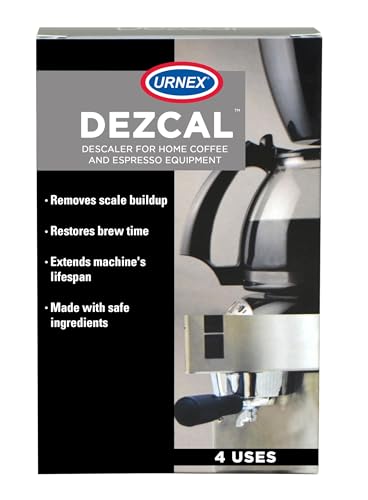
The fix is a descale cycle, run per your machine's manual (the Bambino Plus and Barista-line machines have specific descale modes). Use a proper descaling product: Breville's own BES007 descaler is the play-it-safe option, and Urnex Dezcal is the community-standard alternative that costs less per use as of mid-2026. Do not use vinegar; Breville advises against it, and it is both weaker on scale and hard on seals.
Stubborn cases need two rounds: heavy scale rarely dissolves in one pass. And if you do not know how often you should be descaling in the first place (it depends entirely on your water hardness), our descaling schedule guide covers the per-machine intervals, the test strips, and the water strategies that slow scale to a crawl.
Fix 3: o-ring wear at the ball joint
Different symptom, different part. If steam output is fine but the wand leaks, drips, or hisses at its pivot joint, or the wand has gotten floppy and will not hold position, the small rubber o-rings inside the ball joint have hardened or worn. They are consumables: heat cycles age them, and owner reports commonly describe needing them somewhere past the first year or two of regular steaming.
The fix: replacement o-rings for Breville wands cost a few dollars (o-ring and seal kits for Breville machines on Amazon, as of mid-2026; match the kit to your model number, which is on a sticker behind the drip tray). On the Barista Express and Pro, the wand joint is accessible enough that careful owners treat this as screwdriver-level work: unplug the machine, let it cool completely, disassemble the joint per the kit's or a reputable teardown's instructions, swap the rings, and reassemble snugly but not gorilla-tight.
The honesty line: if the leak is coming from inside the machine body rather than at the visible joint, stop. Behind the panel is mains voltage and a steam circuit, and on the compact Bambino chassis nearly everything interesting is behind the panel. That is a service job, not a DIY job, and no latte is worth the shock risk. The same replace-or-repair math from our Barista Express problems guide applies: on an older machine, a shop quote for an internal steam leak is sometimes the honest signal to put the money toward the next machine instead.
Bambino Plus: when the problem is the auto-steam system
The Bambino Plus adds a layer no other machine here has: automatic milk texturing governed by a temperature sensor in the drip tray. It works well, and it also generates a family of 'my wand is broken' reports that are actually the sensor doing its job with bad inputs. Before assuming a hardware fault, check these:
Auto cycle stops after a few seconds, or never really starts. The machine reads milk temperature through the base of the pitcher sitting on the sensor pad. Anything that breaks that contact confuses it: the pitcher not seated flat on the pad, a towel or mat under the pitcher, or a third-party pitcher with a thick or ridged base that insulates the sensor. Owner consensus is blunt: use the included pitcher, directly on the tray, for auto mode.
Auto cycle stops 'early' with warm-not-hot milk. Check the temperature setting; the three levels are real and the lowest is genuinely modest. Also note the sensor reads the pitcher, so starting with a warm pitcher shortens the cycle.
A pause before steam ramps up. The Plus's cycle starts gently and builds; owners occasionally mistake the opening seconds for weak steam. Let a full cycle run into water and watch it before judging.
Expecting manual behavior in auto mode. The wand fully down with the pitcher on the pad triggers automatic logic. If you want to drive the milk yourself, use the machine's manual texturing mode per the manual rather than fighting the automation.
If auto steaming misbehaves even with the stock pitcher seated correctly, run the Fix 1 and Fix 2 checks above (the Plus is just as blockable as its siblings, its auto purge notwithstanding), and only then suspect the sensor itself, which is a warranty or service conversation. For the wider question of whether the Plus's automation is worth having at all, our Bambino vs Bambino Plus comparison covers it honestly.
When the machine is fine and the milk is the variable
A wand that froths one milk beautifully and another not at all is not a broken wand. If two milks behave differently in the same session, on the same machine, at the same temperature, the machine has already proved it can steam.
Foam is protein doing the work and fat moderating it. Milk proteins unfold as they heat and wrap around the air you introduce, building the bubble walls that hold microfoam together. Fat softens the texture but competes for space at those walls, which is why skim throws more volume and whole milk gives less foam that feels richer.
Three things shift that balance with nothing changing on the machine:
- Barista-edition plant milks are engineered to froth. Oat, almond and soy barista formulations carry added stabilisers, gums and often extra fat specifically so they behave like dairy under steam. They can froth convincingly on a wand that is already down on power, which is exactly what makes them a useful control: if the oat still works and the dairy has stopped, the dairy is the thing that changed.
- Ultra-pasteurised dairy froths worse than standard pasteurised. UHT processing denatures some of the protein before it reaches your pitcher, leaving less available to build foam. Shops change suppliers and processing without changing the carton, so this can arrive silently in a brand you have bought for years.
- Age matters more than the printed date. Milk near the end of its life froths thinly and collapses fast, well before it tastes wrong.
The test, in one line: steam a fresh, cold, standard-pasteurised dairy from a carton you have not used before. If that froths, the wand is healthy and the milk was the problem. If it does not, go back to the ten second purge test at the top of this guide.
When weak steam is actually normal
Some 'broken' wands are healthy machines being compared to the wrong baseline.
Every machine in this guide (Bambino, Bambino Plus, Barista Express, Barista Pro) steams from a thermoblock or thermocoil: water flash-heated on demand through a compact heating path. That design gives you near-zero warm-up and instant brew-to-steam switching, and it caps raw steam power below what boiler machines produce. A commercial machine or a prosumer dual boiler makes steam in a different weight class. A Gaggia Classic's small brass boiler, once it climbs to steam temperature, also pushes notably harder than a Bambino, as we note in our three-way entry machine comparison.
Realistic expectations for a healthy Breville thermoblock wand, per broad owner reporting: a small latte pitcher of milk textured in roughly 30-60 seconds, continuous steam without dying mid-pitcher, and enough power for one or two drinks back to back without drama. What it will not do is rip a 20 oz pitcher to temperature in 15 seconds, and no cleaning, descaling, or part on this page will change that. It is the architecture.
So the honest test is not 'does it steam like the cafe machine' but 'does it steam like it did when new'. Gradual decline means scale (Fix 2). Sudden death means blockage (Fix 1). Never-was-strong on a small pitcher in under a minute means your machine is probably fine and your expectations were calibrated on a boiler.
The 20 second ritual that prevents all of this
Owner threads are unanimous to a degree rare in this hobby: steam wand problems track cleaning habits almost perfectly. The whole prevention program takes about 20 seconds per drink.
- Before steaming: purge 2 seconds into the drip tray, so you steam with dry steam
- Immediately after steaming: purge 2 seconds again to blow milk out of the tip, and wipe the wand with a damp cloth before the milk dries. Immediately means immediately; milk bakes onto a hot wand in the time it takes to sip the latte
- Weekly: check the tip holes against the light and run the pin through them; on machines with removable tips, give the tip a hot soak
- On schedule: descale per your water hardness, which is the entire subject of our descaling frequency guide
Bambino Plus owners get the post-steam purge automated, which is worth real money over years of ownership, but the wipe is still on you, and so is the descaling.
Do those four things and the pin tool becomes a drawer ornament, which is exactly what you want it to be.
Breville steam wand problems: FAQ
Why is my Breville steam wand not frothing milk?
If steam output is strong but milk will not froth, it is technique: tip position too deep (no air being drawn in) or too shallow (big bubbles), or milk that is too warm to start. If steam output itself is weak or absent, the cause is almost always a milk-blocked tip, and after that, scale in the steam path. Run the purge test first to tell which problem you actually have.
How do I unclog a Breville steam wand?
Let the wand cool, push the pin on the included cleaning tool fully through each hole in the tip several times, soak the tip in hot water (it unscrews on the Barista Express and Pro; on Bambinos, soak it in place with a cup of hot water), then purge hard for several seconds. If output is restored but still weak, run a descale cycle: scale narrows the steam path from the inside.
Why does my Bambino Plus stop steaming after a few seconds?
Usually the automatic system, not a fault. The Plus reads milk temperature through a sensor pad under the pitcher; a pitcher that is not seated flat, a third-party pitcher with a thick base, or a low temperature setting all end the cycle early. Use the included pitcher directly on the drip tray and check the temperature setting. If it still misbehaves, clear the tip and descale before suspecting the sensor.
Is weak steam normal on the Breville Bambino?
Compared to a boiler machine, yes. Thermoblock machines like the Bambino trade raw steam power for instant heat-up, and a healthy Bambino textures a small latte pitcher in roughly 30-60 seconds per owner consensus. Weak compared to its own performance last month is not normal: gradual decline points to scale, sudden loss points to a blocked tip, and both fixes are cheap.
How do I stop my steam wand from clogging again?
Purge for two seconds before and after every steaming session and wipe the wand with a damp cloth immediately after use, before milk residue bakes on. Weekly, check the tip holes and clear them with the pin tool. Descale on a schedule matched to your water hardness. Owner reports are nearly unanimous that wands maintained this way simply do not clog.