Breville Bambino vs Gaggia Classic Pro vs Barista Express: The $300-700 First-Machine Decision
The three machines behind most first-espresso-setup debates on r/espresso solve the same problem three different ways. The right pick depends on your grinder budget, your milk habits, and how much you like to tinker.
Some links below are affiliate links. If you buy through them, BrewTested may earn a small commission at no extra cost to you. We only recommend gear that passes our Fit Analysis, and we publish the ones that don't.
This is the most-asked first-machine question in home espresso, and the honest answer splits three ways.
Pick the Breville Bambino if you want the cheapest reliable route to real espresso and you already accept that a separate grinder is part of the deal. It heats in seconds, steams milk surprisingly well, and stays out of your way.
Pick the Gaggia Classic Evo Pro if you want a serviceable, moddable machine you might still own in ten years, and you are willing to climb a steeper learning curve (and budget for a grinder, and probably mods).
Pick the Breville Barista Express if you want one box on the counter, one purchase decision, and the fastest path from unboxing to latte, and you accept a built-in grinder that community consensus rates as the weakest part of the package.
A note on method: BrewTested has not yet bench-tested these machines ourselves. This comparison synthesizes manufacturer specifications, long-running owner reports on r/espresso and Home-Barista, and community references like the Espresso Aficionados wiki. Our own hands-on ownership logs are just getting started; how we test explains the standard we are building toward.
What each machine actually is
These three get lumped together by price, but they are different species.
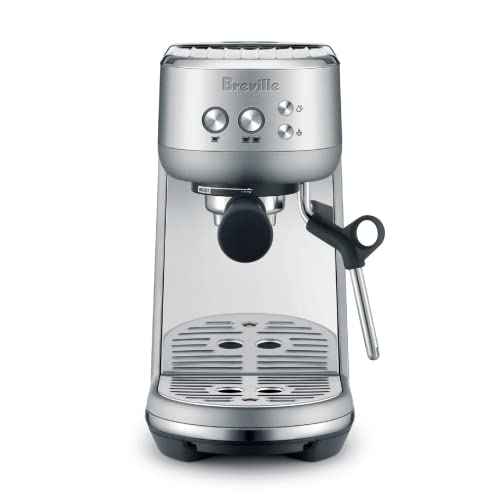
Breville Bambino ($299.95 list). A compact single-boiler-style machine built around Breville's ThermoJet thermoblock heater. Instead of keeping a tank of water hot, it flash-heats water on demand, which is why Breville advertises a 3 second heat-up. You get a 54mm portafilter, programmed shot buttons, and a manual steam wand. No grinder. The step-up Bambino Plus ($499.95 list) adds automatic milk texturing with a temperature probe: it steams the pitcher for you and purges the wand afterward.
Gaggia Classic Evo Pro ($499 list). The current evolution of a design that has existed in recognizable form since the early 1990s: a small single boiler (with an anti-scale coating in the Evo revision), a commercial-style 58mm portafilter, rocker switches, a three-way solenoid valve, and a commercial-style steam wand. It is made in Italy and built from parts you can actually buy and replace. No grinder, no PID from the factory, no shot timer, no hand-holding.
Breville Barista Express ($699.95 list, routinely $549-600 street). An all-in-one: a thermocoil heating system with PID temperature control, a 54mm portafilter, pressure gauge, manual steam wand, and a built-in conical burr grinder with 16 grind settings that doses directly into the portafilter. It is the best-selling semi-automatic espresso machine in North America for a reason: it collapses a two-appliance problem into one purchase.
The deepest technical difference is the heating philosophy. The Bambino's thermoblock heats water as it flows, so brew-to-steam transitions are near instant. The Gaggia's small boiler holds heated water, so switching to steam mode means waiting for the boiler to climb to steam temperature, and temperature control without a PID mod is famously done by feel (owners call it temperature surfing). The Barista Express sits in between: a thermocoil with PID control for brewing, with a wait when you switch to steam.
Manufacturer specs, side by side
| Spec | Bambino | Bambino Plus | Gaggia Classic Evo Pro | Barista Express |
|---|---|---|---|---|
| List price (mid-2026) | $299.95 | $499.95 | $499 ($549 in colors) | $699.95 ($549-600 typical street) |
| Heating system | ThermoJet thermoblock | ThermoJet thermoblock | Single boiler, anti-scale coated | Thermocoil with PID |
| Published power | 1560W | 1560W | 1200W | 1600W |
| Portafilter | 54mm | 54mm | 58mm commercial-style | 54mm |
| Built-in grinder | None | None | None | Conical burr, 16 settings |
| Published pressure | 9 bar extraction | 9 bar extraction | 9 bar extraction | 15 bar pump, 9 bar extraction |
| Steam | Manual wand | Automatic milk texturing (or manual) | Commercial-style wand, boiler switchover | Manual wand |
| Dimensions (approx, W x D x H) | 7.7 x 12.6 x 12.2 in | 7.6 x 12.6 x 12.2 in | 8.0 x 9.5 x 14.2 in | 12.5 x 13.8 x 15.9 in (as listed by Breville) |
| Made in | China | China | Italy | China |
The grinder-first doctrine (read this before comparing machines)
Ask r/espresso which of these to buy and the most upvoted reply usually is not about the machines at all. The standing community doctrine, repeated for years across Reddit, Home-Barista, and the Espresso Aficionados Discord, is that on a budget, grinder quality matters more than machine quality. Espresso lives and dies on grind consistency and fine adjustment, and no machine can fix what a bad grinder feeds it.
That doctrine has a direct dollar consequence: the Bambino and the Gaggia do not include a grinder, and a blade grinder or cheap burr grinder from the department store aisle will not grind fine or consistently enough for real espresso. Community references are blunt about this. Plan on one of these as of mid-2026:
- Baratza Encore ESP, about $199.95, the consensus easy-mode entry espresso grinder (Baratza listing)
- Turin DF54, about $249 list with frequent sales in the $215-230 range, the budget flat-burr favorite (Espresso Outlet listing)
- A quality hand grinder (1Zpresso and similar) in the $150-200 range if you do not mind 45-60 seconds of cranking per dose
So the real comparison is never $300 Bambino vs $550 Barista Express. It is $500-550 (Bambino plus grinder) vs $700-750 (Gaggia plus grinder) vs $550-600 (Barista Express, grinder included). Suddenly the Barista Express's value proposition makes sense, and so does its most common criticism: you are buying a decent machine welded to a mediocre grinder, and you cannot upgrade half of it later.
True cost of ownership: the three paths (mid-2026, USD)
| Path | Machine | Grinder | Typical extras | Realistic all-in |
|---|---|---|---|---|
| Bambino + separate grinder | $299.95 list | $150-250 | Scale, dosing funnel, WDT tool: $50-100 | $500-650 |
| Bambino Plus + separate grinder | $499.95 list | $150-250 | Same accessory kit: $50-100 | $700-850 |
| Gaggia Classic Evo Pro + separate grinder | $499 list | $150-250 | Scale, better tamper, pitcher: $75-125; optional PID and spring mods: $50-250 later | $725-875 before mods |
| Barista Express (all-in-one) | $549-600 street | Included | Scale, WDT tool: $40-75 | $590-675 |
Steam and milk: the fork in the road
If you mostly drink straight espresso or americanos, skip this section; all three will serve you. If you drink lattes and cappuccinos daily, this is the single biggest practical difference between them.
Bambino and Bambino Plus: the thermoblock design means essentially no wait between pulling a shot and steaming. Owner consensus consistently rates Bambino steam as strong for the price, and the recurring advice in Bambino vs Gaggia threads is that milk-drink people should lean Breville. The Plus goes further: automatic texturing with selectable temperature and foam level, and it purges the wand itself. For a household where a non-hobbyist also makes drinks, that button is worth real money.
Gaggia Classic Evo Pro: the commercial-style wand can produce proper microfoam, but the single boiler has to climb from brew temperature to steam temperature, you wait for it, and after steaming you need to cool the boiler back down (owners crack the wand or run water through the group). It is a rhythm you learn, not a flaw exactly, but it makes back-to-back milk drinks the Gaggia's weakest event.
Barista Express: manual steaming off a thermocoil, with a pause while it switches over. Owners generally describe steam as adequate but not fast; stretching a big pitcher takes noticeably longer than on a heat-exchanger or dual-boiler machine. Fine for one or two drinks, tedious for four.
One more milk-adjacent note: getting the shot right matters more to how a latte tastes than the microfoam does. If your shots are sour or harsh, fix that first; our guide to sour vs bitter espresso walks the diagnosis.
Counter space and kitchen reality
The Bambino is the runaway winner on footprint: under 8 inches wide, shorter than a kettle, light enough to slide out from under cabinets. It is the only one of the three that disappears into a small kitchen. Remember, though, that a separate grinder claims its own 5-7 inches of counter next to it.
The Gaggia is narrow (about 8 inches wide) but tall at roughly 14 inches, and again a grinder rides along.
The Barista Express is one wide box: Breville's published dimensions put it at over 12 inches wide with the bean hopper on top, and you want clearance above to refill beans and water. Total counter claim is comparable to a Bambino plus grinder; it is one silhouette instead of two.
Also check your cup habit: all three are espresso machines with modest clearance under the group. Travel-mug-under-the-spouts is not the workflow here.
The tinker factor: why Gaggia owners never stop talking about mods
The Gaggia Classic has something neither Breville offers: a parts-level relationship with its owners. The internals are simple, documented, and standardized, and a whole aftermarket exists around them.
The canonical mods, in the order most owners do them:
- OPV spring swap to bring brew pressure to the community-preferred 9 bar range, a roughly $10-15 part popularized by kits like the Shades of Coffee spring kit
- PID temperature control, the big one, which replaces temperature surfing with a set-and-forget display, typically $100-200 in kit form plus an afternoon of wiring
- Bottomless portafilters, precision baskets, and eventually flow-control devices for the fully committed
We cover the whole ladder in our Gaggia Classic Pro mods guide. The point for a first-time buyer: the Gaggia's stock experience is the roughest of the three, and community references say so plainly, but its ceiling is the highest and its repairability is in a different league. Brevilles are appliances: excellent ones, but when something major fails out of warranty, the usual answer is replacement, not repair. The Gaggia is a machine in the old sense. People rebuild 20-year-old ones for fun.
If reading that list made you tired, that is your answer: buy a Breville. If it made you open a new browser tab, that is also your answer.
Where this comparison comes from: BrewTested has not yet lab-tested these three machines. Everything above synthesizes manufacturer-published specifications, multi-year owner reporting on r/espresso and Home-Barista, and community reference materials, and we have tried to say so at every point where it matters. We are starting live, dated ownership logs on this exact machine class, beginning with the Barista Express. Our testing standards are at how we test.
Verdicts: pick this if
Pick the Bambino ($299.95) if: you want the lowest total cost of entry that does not compromise the espresso itself, you are fine adding a $200 grinder, and you value speed and simplicity. It is the community's default answer to 'cheapest machine worth buying new' and the price-to-shot-quality benchmark this whole tier gets measured against.
Pick the Bambino Plus ($499.95) if: the Bambino appeals but your household drinks lattes daily, or someone else in the house needs drinks to be push-button easy. Automatic milk texturing is the entire upgrade, and for milk-heavy homes it is the right one.
Pick the Gaggia Classic Evo Pro ($499) if: you suspect espresso is about to become your hobby rather than your appliance. Steeper curve, slower milk workflow, and the strong likelihood you spend another $150-250 on mods, in exchange for a 58mm commercial portafilter, total repairability, and the highest ceiling here.
Pick the Barista Express ($549-600 street) if: you want one decision, one box, and a complete workflow today, and you accept that the built-in grinder is the component you will outgrow first. For a lot of people that trade is correct: the Barista Express has probably created more home baristas than any other machine. Read our full long-term Barista Express review before deciding.
Buy none of these yet if: your grinder budget is zero and the all-in-one's compromises bother you. Waiting one more paycheck beats pairing a $500 machine with a $30 grinder; the community graveyard of abandoned setups is full of exactly that pairing.
Bambino vs Gaggia vs Barista Express: FAQ
Is the Breville Bambino good enough for a beginner?
Yes, and it is arguably the best-matched machine for beginners in this group: fast heat-up, forgiving workflow, and strong community support. Its espresso ceiling is high enough that plenty of experienced owners keep one as their only machine. The catch is that it needs a real espresso-capable grinder, which roughly doubles the entry cost.
Do I need a separate grinder for the Bambino or Gaggia Classic Pro?
Effectively yes. Neither includes a grinder, and pre-ground coffee or cheap grinders cannot hold the fine, consistent grind espresso requires. Budget $150-250 for an entry espresso grinder like a Baratza Encore ESP, a Turin DF54, or a quality hand grinder, as of mid-2026 pricing.
Is the Gaggia Classic Pro better than the Breville Barista Express?
Better at different things. The Gaggia has a commercial 58mm portafilter, full repairability, and a big mod ecosystem, so its long-term ceiling is higher. The Barista Express includes a grinder and PID temperature control out of the box, so its first month is far easier. Tinkerers tend to be happier on the Gaggia, convenience buyers on the Breville.
Which machine is best for lattes and milk drinks?
The Bambino Plus, on the strength of its automatic milk texturing and instant brew-to-steam switching. The standard Bambino is next with fast, capable manual steam. The Barista Express steams adequately but more slowly, and the Gaggia is the most effortful for milk because its single boiler must climb to steam temperature and cool back down between drinks.
Is the Breville Barista Express grinder good enough?
Good enough to start, and the machine's built-in PID and pressure gauge help you learn. But owner reports and community references consistently rate the integrated grinder as the package's weak point for consistency and longevity, and it is the component owners outgrow first. If you already know you will want a better grinder within a year, buying a Bambino plus a separate grinder for similar money is the more upgrade-friendly path.