Best French Press (2026): What More Money Actually Buys
Every French press makes coffee. The differences are filtration, heat retention, and whether you can replace the part that wears out. Here is what each price tier gets you, and the spec on the box that is quietly lying to you.
Some links below are affiliate links. If you buy through them, BrewTested may earn a small commission at no extra cost to you. We only recommend gear that passes our Fit Analysis, and we publish the ones that don't.
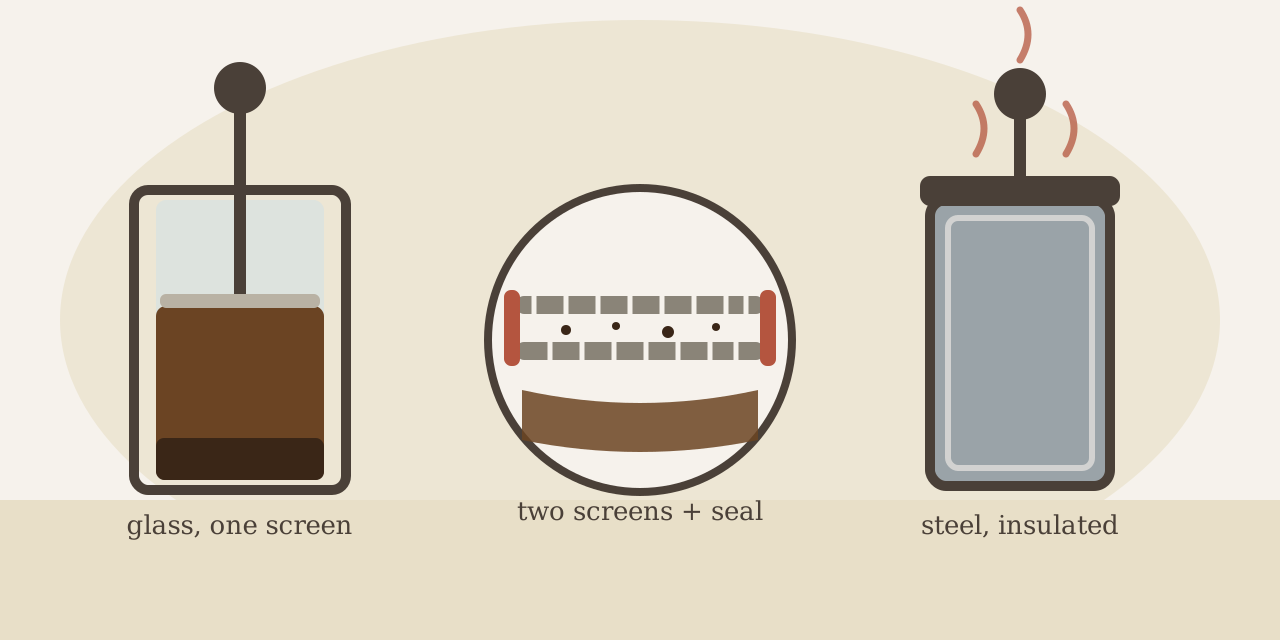
The single upgrade that changes the coffee in the cup is the filter, not the body. A conventional press uses one mesh screen, which is why the last two ounces are silty and why the brew keeps extracting after you plunge. A double micro-filter design closes most of that gap, and it is the reason the Espro P3 is our default recommendation at around the $40 mark rather than the cheaper single-screen presses it sits next to.
The second upgrade is heat, and it costs more than the first. Glass loses temperature through the brew and keeps losing it while you drink. Double-walled stainless does not, which matters if your press sits on the counter for twenty minutes rather than four. The Espro P7 combines both upgrades; the Frieling does insulation and a dual screen for less.
The Bodum Chambord remains the honest cheap answer and the reason this category has been coasting for a decade. It is a single-screen glass press with sixty years of parts availability behind it. If your grinder is good, it makes very good coffee and you can spend the difference on beans.
The thing that actually ruins French press coffee is not the press. It is fines from a blade grinder or an inconsistent burr set, and no amount of filtration fixes them. If you are choosing between a $90 press and a $90 grinder, buy the grinder.
Method note, stated plainly: BrewTested has not bench-tested these presses. This is manufacturer specification, published design detail, and owner-report synthesis. Standards we are building toward: how we test.
Why this guide exists
Somebody went looking for French press advice this month and reported back that everything they found on the biggest coffee forum was five to twelve years old. That is a fair description of the category. Immersion brewing got solved, the internet moved on to espresso and pour-over, and the buying advice fossilised around "get a Bodum".
"Get a Bodum" is not wrong. It is just incomplete, because the presses that came after it changed one specific thing, and nobody explains which thing or whether it is worth the money.
So this piece answers the actual question rather than ranking twelve near-identical cylinders: what does more money buy in a French press? There are four answers, in descending order of how much they matter.
1. Filtration: the only upgrade you taste
A standard press filter is one stainless mesh disc held against the glass by a spring skirt. Its job is to hold back grounds when you plunge, and it does that adequately and nothing more. Two consequences follow, and every French press complaint traces to one of them.
Silt in the cup. Mesh has a hole size; coffee grounds have a size distribution. Anything smaller than the mesh comes through, which is why the bottom inch of a conventional press is sludge and why people pour carefully and leave the last two ounces behind.
Extraction that does not stop. Plunging separates most of the grounds from most of the water, but a single screen leaves plenty of contact around the edges and below. Coffee left in a conventional press keeps extracting and gets harsher by the minute. That is the real reason the second cup tastes worse, not the temperature.
The design answer is a double filter with a seal at the wall. Espro's patented double micro-filter is the best-known implementation and the company describes it as filtering twice for a grit-free brew, with a double silicone seal that traps the over-brewed coffee at the bottom. Frieling takes a different route to a similar place with a patented two-stage dual-screen filter it describes as zero-sediment.
How much difference does it make? Honest answer: enough that owners of both consistently describe the double-filtered cup as cleaner and closer to a filter-coffee body, and not so much that a single-screen press with good coffee in it is bad. It is the upgrade most worth paying for, and it is also the cheapest one — the P3 delivers it at glass-press money.
2. Heat retention: worth it only if you are slow
Borosilicate glass is thin, and it is a window. A glass press loses heat during the four-minute brew and keeps losing it while the coffee sits.
Double-walled stainless is a vacuum flask with a plunger in it. Frieling claims its double-walled body and lid keep coffee hot up to four times longer than glass, which is a manufacturer figure and not one we have measured — but the direction of it is not in dispute.
Whether that is worth $60 to $100 depends entirely on your habits. If you brew 12 oz and drink it in ten minutes, glass is fine and insulation is a solved problem your mug already handles. If you brew 32 oz for two people over half an hour, or you take the press camping, or your kitchen is cold, insulation is the difference between a good second cup and a lukewarm one.
The other thing steel buys is that it does not break. Glass carafes are the number-one failure point of the category, and while replacements are cheap and available for the major brands, "cheap and available" is still a trip to the checkout and a week without coffee.
What steel costs you: you cannot see the brew, which matters more than it sounds when you are learning the bloom and the crust, and the body is heavier and slower to cool for cleaning.
3. Replaceable parts: the spec nobody checks
This is the one to look at before you buy, because it decides whether you own the press for two years or fifteen.
A French press has exactly two consumable parts: the filter assembly, whose mesh and seal degrade, and the glass, which breaks. Everything else is a metal frame that outlives you.
So the question is whether the manufacturer sells those two parts separately. Espro does — replacement micro-filters covering the P3, P5 and P7, and replacement glass carafes for the 32 oz glass models are stocked as their own listings. Bodum has sold Chambord spares for decades, which is a large part of why the Chambord is still the default recommendation.
The presses to avoid on this axis are the unbranded stainless ones that undercut everything by $15. They are usually fine on day one. They have no spares channel at all, so a torn mesh is a new press.
Buying rule: before you order, search for the replacement filter for that exact model. If it does not exist as a listing, you are buying a disposable.
4. Capacity, and the number on the box that is lying
French press capacity is quoted in "cups" that are 4 oz each, which is not a cup by any definition anyone uses at home. A "8 cup" press is 34 oz. That much is a known convention.
The less-known part is that the ounce rating is usually total water volume, not brewed coffee. The grounds displace some, the plunger displaces more, and you cannot fill to the brim. Espro is unusually straight about this: it states that its 32 oz P7 holds 48 oz of water and delivers 32 oz of coffee. Most brands quote the larger number.
Practical translation, assuming you want real mugs rather than 4 oz cups:
- 17-18 oz press: one large mug, or two small ones. Fine for one person.
- 32-36 oz press: two large mugs comfortably, three at a push. This is the size most households should buy.
- 51 oz press: genuinely four to five mugs, and hard to plunge evenly. Buy it only if you regularly brew for a group.
Buy for the number of mugs you actually pour. An underfilled press brews badly — the ratio drifts, the bed is too shallow, and the plunger sits above the slurry.
The field, compared
| Press | Body | Filtration | Spares available | Who it is for |
|---|---|---|---|---|
| Espro P3, 32 oz | Borosilicate glass, stated 40% thicker, twist-lock carafe latch | Patented double micro-filter, double silicone seal | Filter and carafe both sold separately | Most people. The filtration upgrade at glass-press money |
| Bodum Chambord, 34 oz | Borosilicate glass in a stainless frame, made in Portugal | Single stainless mesh plate with spring skirt | Long-standing spares channel | Anyone whose budget is better spent on the grinder |
| Frieling, 36 oz | 18/10 stainless, double-walled, dishwasher safe | Patented two-stage dual screen, described as zero sediment | Manufacturer spares available | Insulation and unbreakability without Espro P7 pricing |
| Espro P7, 32 oz | Double-walled 304 stainless, insulated, shatterproof | Patented double micro-filter | Filter sold separately | Both upgrades in one press; the endgame of the category |
Espro P3: our default recommendation
The P3 is the press that makes this whole guide simple, because it puts the upgrade that matters most into the price bracket where most people were shopping anyway.
What you get: the patented double micro-filter, a double silicone seal that Espro says traps the over-brewed coffee at the bottom of the press rather than letting it sit in your carafe, borosilicate glass the company states is 40% thicker than standard, a twist-lock latch that secures the carafe in the frame while you pour, and dishwasher-safe, BPA-free construction.
What you give up against the steel presses: heat retention, and the risk of a broken carafe. Both are real; neither is a reason to buy a single-screen press instead.
The thing we would flag before you buy: Espro presses need a slightly coarser grind and a firmer plunge than a conventional press, because you are pushing water through two filters rather than one. Owners who describe the plunge as stiff are usually grinding too fine. This is fixable in five seconds on the grinder and it is not a defect.
Bodum Chambord: still the honest cheap answer
The Chambord is the shape everyone pictures when they hear "French press", and it has not needed redesigning. Borosilicate glass in a polished stainless frame, a single mesh filter plate, made in Portugal, available in seven finishes and three sizes, spares stocked for decades.
It has exactly the compromises described above: silt in the last of the pour, coffee that keeps extracting if you leave it, no heat retention. And it makes genuinely good coffee anyway, which is why it survived the entire specialty-coffee boom without changing.
Buy it if your grinder is the weak link in your setup, which it usually is. A Chambord plus a decent burr grinder beats a P7 plus a blade grinder by a distance that is not close. The press cannot filter out inconsistency that was created upstream.
Frieling and the Espro P7: the insulated tier
These are the two presses worth paying up for, and they answer slightly different questions.
Frieling, 36 oz. 18/10 stainless inside and out, double-walled, with a patented two-stage dual-screen filter the company describes as zero-sediment. Frieling claims the insulated body and lid hold heat up to four times longer than glass. All parts dishwasher safe. It is the practical choice for a household that brews a large press and drinks it over an hour, and for anyone who has already broken one carafe.
Espro P7, 32 oz. Double-walled 304 stainless with the same patented double micro-filter as the P3. It is the only press here that does both upgrades properly, and it is priced accordingly. Espro states the 32 oz model holds 48 oz of water to deliver 32 oz of coffee, and that the outer body stays cool while the contents stay hot.
Which one: if filtration is what you care about, the P7. If insulation and durability are what you care about and you are happy with a good dual screen, the Frieling, which typically costs less. Neither is a sensible first press unless you already know you brew large and slow.
The picks
Prices in this category move constantly and every one of these goes on sale, so we do not quote them. Buy the tier that matches how you actually drink.
 BrewTested Pick
Espro P3, 32 oz
The double micro-filter at glass-press money. Thicker borosilicate, twist-lock carafe latch, dishwasher safe, and both the filter and the carafe are sold as spares. The default recommendation for almost everyone.
Check price on Amazon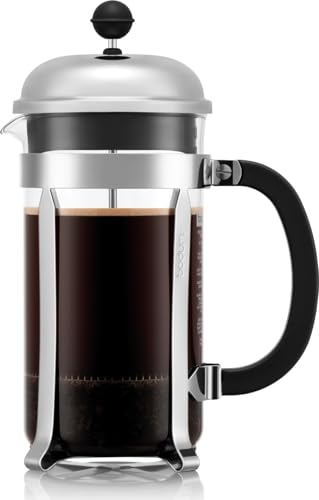 Best value
Bodum Chambord, 34 oz
Borosilicate glass in a stainless frame, made in Portugal, single mesh filter, spares stocked for decades. Single-screen compromises and all, it makes very good coffee if the grind is right.
Check price on Amazon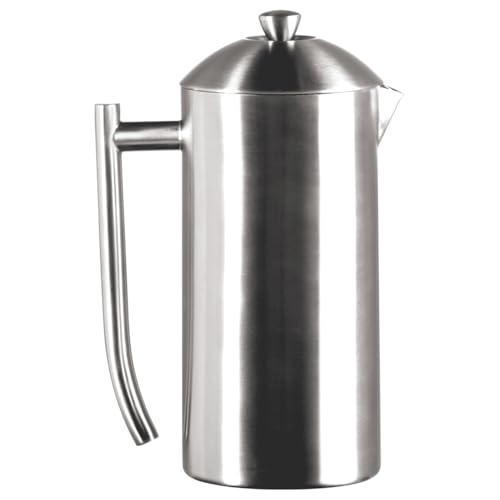 Insulated, unbreakable
Frieling double-walled, 36 oz
18/10 stainless double-walled body with a patented two-stage dual-screen filter. Frieling claims up to four times the heat retention of glass. Dishwasher safe throughout, and nothing on it can shatter.
Check price on Amazon Both upgrades
Espro P7, 32 oz
Double-walled 304 stainless plus the patented double micro-filter. Espro states it takes 48 oz of water to deliver 32 oz of coffee, and that the outer body stays cool. The endgame press, priced like it.
Check price on Amazon The part that wears out
Espro replacement micro-filter
Fits the 32 oz P3, P5 and P7. Buy one before you need it, and check that an equivalent exists for whatever press you end up choosing. A press without a spares listing is a disposable.
Check price on Amazon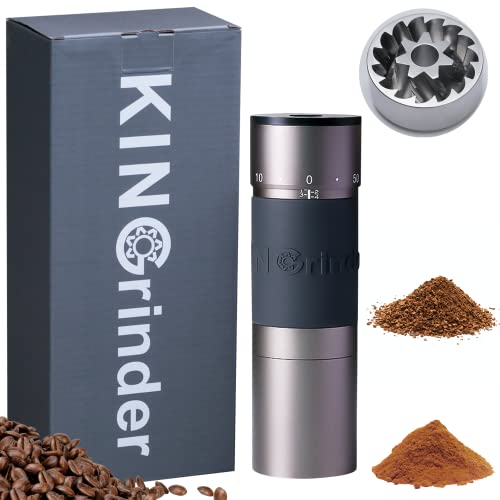 Buy this before a better press
KINGrinder K6 hand grinder
Stainless conical burrs, external adjustment at roughly 16 microns per click, 30-35 g capacity. Coarse immersion grinding is the least demanding job a burr grinder does, which makes this the cheapest real fix for muddy French press coffee.
Check price on AmazonThe grinder is the actual variable
Everything above is worth maybe twenty percent of the cup. The grind is worth the rest, and it is where French press advice usually stops right before it becomes useful.
Immersion brewing wants a coarse, uniform grind. Coarse, because the coffee sits in water for four minutes and fine grounds over-extract into bitterness in that time. Uniform, because fines are what produce both the silt and the harshness, and a filter can only catch the ones larger than its mesh.
A blade grinder cannot produce this. It cannot produce any grind size; it produces a distribution, from powder to chunks, in one go. That is the single biggest cause of bad French press coffee and no press design compensates for it.
The good news is that coarse immersion grinding is the easiest job a burr grinder does. The tolerances that make espresso grinders expensive do not apply. A hand grinder such as the KINGrinder K6 is more than enough, and it takes far less effort at coarse settings than it does at espresso fineness.
If you are also heading toward espresso eventually, our under-$200 espresso grinder roundup covers the machines that do both, and grinder first or machine first explains why the grinder keeps winning that argument.
How to brew it, in five lines
Not a recipe post, but the method changes the verdict on the hardware enough to be worth stating.
- Ratio: start at 1:15 by weight — 60 g of coffee to 900 g of water for a full 32 oz press. Adjust to taste, not to a scoop.
- Grind coarse, roughly sea salt. If the plunge is a fight, you have gone too fine.
- Bloom: pour twice the coffee weight in water, wait 30 seconds, then fill.
- Break the crust at four minutes, skim the foam, then plunge slowly and stop at the surface of the bed.
- Decant immediately if you are using a single-screen press. This is the step people skip, and it is the whole reason conventional presses have a reputation for bitterness.
A scale is worth more here than any press upgrade, and a cheap one is fine — you are weighing 60 g, not 18.0 g.
If you take one thing from this page: the press affects clarity and temperature, and the grinder affects everything else. A $30 press with good grounds beats a $130 press with bad ones, every time, and it is not close.
French press: FAQ
Is an expensive French press worth it?
Two of the upgrades are worth paying for and the rest are not. Double filtration measurably changes what is in the cup and costs very little — an Espro P3 sits in the same price bracket as a good conventional glass press. Insulation costs considerably more and only pays off if you brew large volumes or drink slowly. Past those two things, extra money buys finish and brand, not coffee.
Glass or stainless steel French press?
Glass if you want to see the brew, want the lowest price, and drink your coffee promptly. Stainless if you brew a big press and drink it over half an hour, take it camping, have small children in the kitchen, or have already broken one carafe. The trade is visibility and price against heat and durability; both make the same coffee at the moment of plunging.
Why is my French press coffee muddy?
Almost always fines from the grinder rather than the press. A blade grinder produces a wide size distribution including powder, and no mesh catches particles smaller than its holes. Fix the grind first with a burr grinder at a coarse setting. If it is still silty after that, a double-filter press will catch most of what remains — but in that order, because a better press cannot un-make fines.
How many ounces do I actually get from a 34 oz French press?
Less than 34, because the rating is usually total water volume before you account for the grounds and the plunger. Espro is unusually explicit about the difference, stating that its 32 oz press takes 48 oz of water to yield 32 oz of coffee. As a planning figure, expect a "34 oz / 8 cup" press to comfortably fill two large mugs and stretch to three.
Should I leave coffee in the French press after plunging?
Not in a conventional single-screen press. Plunging separates most of the grounds from most of the water but not all of it, and the brew keeps extracting and getting harsher. Decant into a mug or a thermos immediately. Double-filter designs with a seal at the wall reduce this considerably, which is one of the practical arguments for them, but decanting is still the safe habit.
What grind size for French press?
Coarse, in the region of sea salt or slightly coarser, and consistent. The specific number on your grinder matters less than the two symptoms: a plunge that fights you means too fine, and a thin, sour cup with a fast plunge means too coarse. Adjust one direction at a time and give each change a full brew before judging.
Related reading
This is BrewTested's first immersion guide — the rest of the site is espresso, so if you arrived here from a search and want the other half of the house, start with how to split an espresso budget for how the money divides between machine and grinder, and grinder first or machine first for why that order is not a matter of taste. If the immersion route is where you are staying, the under-$200 grinder roundup is still the right list — the grinders that handle espresso handle coarse immersion trivially.