Best Gooseneck Kettles (2026): What Temperature Control Actually Buys You
Your kettle sets one of the three temperatures involved in brewing a cup, and it is not the one that extracts your coffee. What that means for whether you need a second pour kettle, why the spout matters more than the display, and five picks from around $40 to $200.
Some links below are affiliate links. If you buy through them, BrewTested may earn a small commission at no extra cost to you. We only recommend gear that passes our Fit Analysis, and we publish the ones that don't.
A variable-temperature electric gooseneck is the whole category now, and you do not need to spend $200 on one. The Cosori gooseneck does the same three jobs as the expensive ones (set a temperature, hold it, pour slowly and precisely) for around $70 as of mid-2026, and it is the sub-$100 entry point most brewing setups should start at.
The reason people still ask about a second pour kettle is historical. Boiling in one vessel and decanting into another was how you landed a target temperature before affordable kettles could simply be set to one. The transfer does drop the water several degrees, and that was the point. If your kettle can be set to 205°F directly, you have replaced a workaround with a setting.
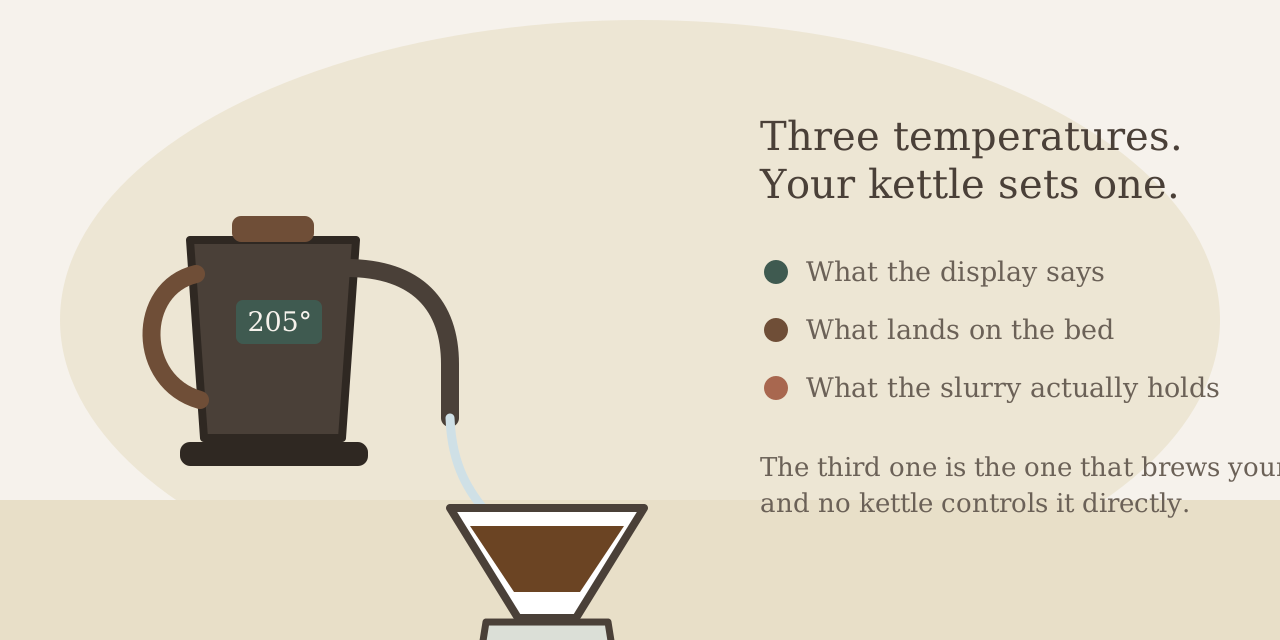
But here is the part no listing mentions: your kettle only controls one of three temperatures. There is what the display reads, what actually lands on the coffee bed after travelling through a cold spout and cold air, and what the slurry holds during extraction. The SCA's home brewer standard measures the third one, not the first, precisely because the others do not predict it. That is why preheating your brewer and rinsing the filter moves your coffee more than 2 degrees on the kettle ever will.
Spend the money on the spout, not the screen. Flow control is what a gooseneck is for, and a Fellow Stagg EKG at around $165 earns its price on pour quality and build rather than on temperature precision anybody else lacks. If you never need temperature control at all, a stovetop Hario Buono around $50 pours beautifully and will outlive every electric kettle here.

Why this guide exists
Someone asked us a question that no product listing answers, and it is a better question than "which kettle is best":
If an electric gooseneck can be set to a temperature and holds it, why do people still boil in one kettle and pour into another? Is the transfer between them really what lands the right temperature on the coffee?
That is worth answering properly, because the honest answer changes what you should buy. It also exposes something the whole category quietly leans on: kettles are marketed on temperature precision, and temperature precision is the part of your brew you have the least control over.
BrewTested has not bench-tested kettles. Everything below is manufacturer specification, published standards, and reasoning from both. Where a claim is the maker's, we say so.
1. The three temperatures, and why your kettle sets only one
Brewing coffee involves at least three distinct temperatures that people routinely talk about as if they were the same number.
The kettle reading. What the display says the water is, measured at whatever point the sensor sits. This is the only one you set.
The contact temperature. What the water actually is when it lands on the grounds. Between the sensor and the coffee it travels through a metal spout at room temperature, then falls through air as a thin stream with a lot of surface area for its volume. It arrives cooler, and how much cooler depends on your spout, your pour height, and how thin your stream is.
The slurry temperature. What the mixture of water and grounds holds while extraction is actually happening. This is the number that brews your coffee, and it is affected by the dry weight of the coffee bed, the mass and material of the brewer, whether the paper filter was rinsed with hot water, the ambient temperature of your kitchen, and the fact that you are pouring in stages with pauses.
The Specialty Coffee Association's brewing range is 195 to 205°F (about 90.5 to 96°C), and the useful detail is where they measure it. The SCA's home brewer standard specifies slurry temperature, not the temperature of water leaving the machine, because everything between those two points pulls heat out.
This is why pour-over guidance so often says to start at the top of the range. A cone dripper is an open, thin-walled brewer that sheds heat continuously, so 205°F in the kettle is a way of arriving somewhere reasonable, not a claim that your coffee brews at 205.
The practical ranking, which inverts what most people spend on:
- Preheat the brewer and the carafe, and rinse the paper filter with hot water. This is free and it is the largest single lever.
- Use enough coffee and a sensible ratio. Thermal mass helps you.
- Set a sensible kettle temperature.
- Worry about whether your kettle is accurate to 1 degree or 5.
2. So do you still need a second pour kettle?
For most people in 2026, no. The two-kettle workflow is a solution to a problem that a $70 kettle now solves with a button.
Here is where it came from. Boil a kettle and you have water at 212°F, which is above the brewing range for most coffee. Pour that into a second vessel and you lose several degrees to the transfer and to the cold metal of the receiving kettle, landing you somewhere in the low 200s. People calibrated that by feel: boil, decant, wait thirty seconds, pour. It worked, and it was the only method available if your kettle had one switch.
A variable-temperature kettle removes the guesswork by holding the number you asked for. Setting 205°F is strictly more repeatable than boiling and estimating a loss you never measured.
Three cases where a two-vessel workflow still makes sense, none of which is about temperature accuracy:
- Volume. Electric goosenecks are small, typically 0.8 to 0.9L, because a narrow spout kettle is awkward when heavy. If you are brewing a litre of coffee, or coffee and tea for several people, boiling in a big kettle and filling the gooseneck is a workflow decision, not a temperature one.
- You already own a good stovetop kettle and want gooseneck pouring without buying another appliance or giving up counter space. Boil in the one you have, decant into a stovetop gooseneck, accept the drift.
- You want it hotter than your kettle will go, which occasionally comes up with very light roasts where people brew at or near boiling. Rare, and mostly it means you should buy a kettle that goes to 212.
What the transfer is genuinely bad at is repeatability. The loss depends on how cold the second kettle was, how much water you moved, and how long you took. It is a variable you cannot see, in the one part of the process people most want to control.
3. The spout is the spec that matters, and nobody compares it
Gooseneck kettles exist for flow control. That is the entire point of the shape: a long, narrow, curved spout turns a glug into a stream you can start, stop, steer and slow.
Every review compares temperature accuracy because it is a number. Almost nobody compares pour quality because it is not. So here is what to actually look at:
- Spout taper and tip. A narrower tip gives a finer stream and more control at low flow. A wider one fills faster and is more forgiving, which some people prefer for immersion brewing where precision is irrelevant.
- Where the spout leaves the body. Spouts that leave low, near the base, keep pouring consistently as the kettle empties. Spouts that leave high change behaviour a lot between full and nearly empty.
- Handle balance. Fellow specifically designs the Stagg EKG's handle as counterbalanced, moving the centre of mass back toward your hand, and Cosori makes the same claim. This is not marketing. A kettle that wants to tip forward makes you fight it, and fighting it is how you get an uneven pour.
- Weight, full. The Stagg EKG Pro is listed at 4.14 lb empty. Add 0.9L of water, roughly 2 lb, and you are holding six pounds at arm's length while trying to move in slow circles. This is the spec that decides whether pouring feels calm or shaky, and it is the reason a lighter stovetop kettle can be more pleasant to pour than an expensive electric one.
- Lid security. A lid that shifts when you tip past 45 degrees is a burn waiting to happen.
If you can, pour water from a friend's kettle before buying. You will learn more in thirty seconds than from any spec sheet, this one included.
4. Presets, hold, and what accuracy claims actually mean
The three electric features worth understanding.
Set temperature. Every variable kettle here lets you pick a number, generally from about 104°F up to 212°F. Precision claims vary: Cosori claims within 5°F of the set point, Fellow markets to-the-degree control. The honest framing is that a 5-degree band at the kettle is smaller than the drop between kettle and slurry that nobody is measuring at all, so this specification is far less decisive than its prominence suggests.
Hold. The kettle keeps the water at the set temperature rather than letting it fall. Cosori's is 60 minutes; Fellow's holds for up to 60 minutes on the EKG. This is genuinely the most useful electric feature for real kitchens, because it means the second cup is the same as the first and a distraction does not cost you a reboil. It matters more for tea than coffee.
Presets. Buttons for common temperatures. Useful if you drink several kinds of tea, largely irrelevant if you brew coffee at one temperature every day.
One thing to keep in perspective: the displayed temperature is the temperature at the sensor. Water in a kettle is not perfectly uniform, particularly right after heating stops, and no consumer kettle tells you about that. Treat the display as a good, repeatable indication rather than a laboratory measurement, which is all you need it to be.
Also worth knowing before you spend up: features like scheduling, app control and a brew stopwatch are real on the higher Fellow models and are convenience, not cup quality. Nothing in this paragraph changes how your coffee tastes.
5. Capacity and counter space, the two specs people regret
Electric goosenecks cluster at 0.8 to 0.9L, and that is smaller than it sounds once you use it.
A single V60 at a 1:16 ratio with 20g of coffee needs about 320g of water, plus water to rinse the filter and preheat the brewer, which can be another 200 to 300g if you are thorough. That is most of a 0.8L kettle for one brew. Two mugs of pour-over plus preheating will empty it.
If you regularly brew for more than one person, or you make tea as well, that is the case for either a stovetop kettle at 1.0 to 1.2L or the two-vessel workflow above.
The second regret is footprint. An electric gooseneck occupies its base permanently, and the bases are not small: both the Cosori models here are listed at 11.6 by 9 inches. A stovetop Hario Buono at 1.2L is listed at 11.1 by 6 by 6.1 inches and lives on the hob or in a cupboard. If your counter is already carrying a machine, a grinder and a scale, this is a real consideration and not a trivial one.
The field, compared
| Kettle | Type | Capacity | Listed weight | Temperature control |
|---|---|---|---|---|
| Hario V60 Buono, stovetop | Stovetop | 1.2L | 0.93 lb | None. Use a thermometer or the boil-and-wait method |
| Cosori Gooseneck | Electric | 0.8L | 3.53 lb | Variable, 5 presets, 60-minute hold, claimed within 5°F |
| Cosori Smart Gooseneck | Electric | 0.8L | 2.57 lb | Variable plus app control, 104 to 212°F |
| Hario V60 Buono, electric | Electric | 0.8L | 2.43 lb | Variable, the Hario spout on a powered base |
| Fellow Stagg EKG | Electric | 0.9L | Approx 3.5 lb | To-the-degree, hold up to 60 min, brew stopwatch |
| Fellow Stagg EKG Pro | Electric | 0.9L | 4.14 lb | To-the-degree, LCD, scheduling, brew timer |
Cosori Gooseneck: the answer for most people
At around $70 as of mid-2026, this is where the category stopped being a luxury purchase. You get variable temperature, five presets, a 60-minute hold, a stainless interior with no plastic touching the water, and a spout and counterbalanced handle designed for pour-over flow rates. Cosori claims accuracy within 5°F of the set point, and 1200W gets 0.8L up to temperature in a few minutes.
It is listed at 11.6 by 9 inches with the base and 3.53 lb, so it is not a small object on a counter, and it is heavier in the hand than the stovetop options.
The case against spending more: nothing above this price makes your coffee taste better. The case for spending more is pour feel, build quality and industrial design, which are real things to want but are not extraction.
The Smart version adds app control and is listed a pound lighter at 2.57 lb. Buy it if you want the app; there is no brewing argument for it.
Fellow Stagg EKG: what the extra money is actually for
The Stagg EKG has been the default recommendation in specialty coffee for years, and at around $165 as of mid-2026 it costs more than twice the Cosori. It is worth being precise about what that buys, because it is not accuracy.
It buys a pointed spout tuned for a fine, controllable stream, a counterbalanced handle that Fellow designed specifically to encourage a slower pour, a 1200W element, to-the-degree setting between 104 and 212°F, an hour of hold, a built-in brew stopwatch, and a build people are still using a decade later. It also buys a small base, which matters more than it should on a crowded counter.
What it does not buy is a better extraction than a competent $70 kettle used carefully. Buy it if you pour every day and enjoy the object, or if you have found cheaper kettles awkward to control. Do not buy it expecting the coffee to change.
The EKG Pro at around $200 adds an LCD, scheduling and a more configurable interface, and is listed at 4.14 lb. That is a heavy kettle before you add water, which is a genuine consideration for a slow pour.
Hario V60 Buono: the case for no electronics at all
The stovetop Buono is the kettle a lot of experienced brewers quietly go back to. It is around $50 as of mid-2026, listed at 1.2L and 0.93 lb, works on gas, electric and induction, and it has no display, no base, no firmware and nothing to fail.
The spout is the reason it has lasted. Hario's gooseneck is the shape most of the category copied, and at under a pound empty it is the lightest and most controllable thing here to actually pour with.
You give up temperature setting and hold. In exchange you get more capacity, a fraction of the weight, no counter footprint, and a kettle that will still be working when three electric ones have died. If you want a number, a $15 instant-read thermometer plus this kettle is cheaper than any variable-temperature model and teaches you more about your own process.
There is also an electric Buono, listed at 0.8L and 2.43 lb, if you want the Hario spout with a powered base.
The picks
Selected on published specifications, manufacturer claims and the standards referenced above. BrewTested has not bench-tested kettles and claims no measurements; dimensions and weights come from Amazon product data. Prices in this category move and everything here goes on sale, so treat any figure as an approximate mid-2026 street price rather than a quote.
BrewTested PickCosori Gooseneck Electric Kettle, 0.8L
The sensible default. Variable temperature with five presets, a 60-minute hold, no plastic in the water path, and a spout and handle designed for pour-over control. Claimed within 5°F of the set point, 1200W. Listed at 3.53 lb. Nothing more expensive will make your coffee taste better.
Check price on Amazon Best pour, no electronics
Hario V60 "Buono" stovetop, 1.2L
The original gooseneck shape, listed at 0.93 lb and 1.2L, working on gas, electric and induction. Lightest kettle here to pour with, largest capacity, zero counter footprint and nothing to break. Pair it with a cheap instant-read thermometer and you have the whole category covered for under $70.
Check price on Amazon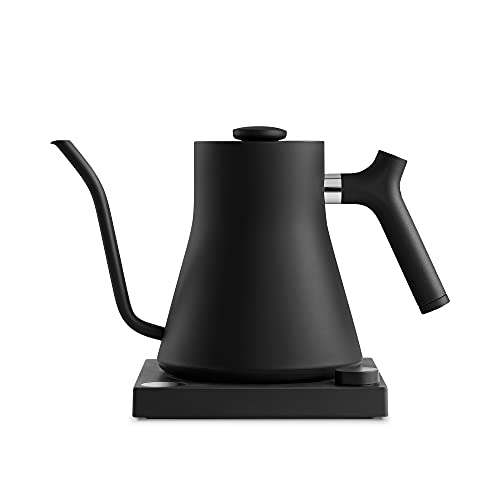 The upgrade, honestly framed
Fellow Stagg EKG
To-the-degree control from 104 to 212°F, up to an hour of hold, a brew stopwatch, a pointed spout built for a fine stream and a deliberately counterbalanced handle. A small base, which matters on a full counter. You are buying pour feel and build, not a better extraction. Worth it if you brew by hand every day.
Check price on Amazon If you want the app
Cosori Smart Gooseneck, 0.8L
The same kettle with app control and scheduling over Bluetooth, listed a pound lighter at 2.57 lb. Set and monitor from a phone, which is genuinely handy for tea and irrelevant for coffee you are standing over. Buy for the convenience, not for the cup.
Check price on Amazon Top of the range
Fellow Stagg EKG Pro
Adds a colour LCD, scheduling and a built-in brew timer to the EKG. Listed at 4.14 lb empty, which is around six pounds with water in it, so try the pour before committing if a slow steady stream is what you are after. Excellent object, and the least necessary purchase on this page.
Check price on AmazonIf you are buying a kettle to fix inconsistent coffee, check the order of your spending first. A gooseneck kettle improves pour control and repeatability, both of which are real. Grind quality and consistency sit above it by a wide margin, and so does using a scale. Our guide on how to split your espresso budget makes the same argument with numbers, and it applies just as well to filter brewing.
Gooseneck kettles: FAQ
What temperature should I set my kettle to for pour-over?
Start at 205°F and adjust by taste. The SCA brewing range is 195 to 205°F measured at the slurry, and an open cone dripper loses heat continuously, so setting the top of the range is a way of arriving somewhere sensible rather than a claim that your coffee brews at 205. If your cup tastes sour and thin, go hotter or grind finer. If it tastes harsh and drying, go cooler or grind coarser. Darker roasts generally want the lower end of the range because they are more soluble to begin with.
Do I need to pour from one kettle into another to hit the right temperature?
Not if your kettle can be set to a temperature. That workflow existed because a kettle with one switch gives you 212°F and nothing else, and the transfer into a second cold vessel dropped it into the brewing range. A variable-temperature kettle does the same job repeatably, and the transfer method has an invisible variable in it, since the loss depends on the second kettle temperature, the volume moved and how long you took. Two vessels still make sense for volume or if you already own a good boiling kettle.
Is an expensive gooseneck kettle worth it?
For extraction, no. A kettle around $70 with variable temperature and a decent spout puts water on coffee at the same temperature as one at $200. What the money buys is pour feel, handle balance, build quality, a smaller base and design you enjoy looking at. Those are legitimate reasons to spend, they just are not taste reasons. If your budget is finite and your grinder is a blade grinder or an entry burr, the grinder is the upgrade that changes the cup.
Can I use a gooseneck kettle for tea?
Yes, and this is where variable temperature earns its keep more than it does for coffee. Green and white teas want water well below boiling, often 160 to 180°F, and getting there by boiling and waiting is imprecise. Presets and a long hold are genuinely useful if the household drinks several kinds of tea. If you only brew coffee at one temperature, presets are a feature you will use once.
Do I need temperature control at all?
No, and plenty of good brewers do without it. Boil, take the kettle off the heat, and wait roughly thirty to sixty seconds before pouring, or use an instant-read thermometer for a few weeks until you learn what your kettle does. That is less repeatable than a set point, and it costs nothing. The one thing worth avoiding is pouring water straight off a rolling boil onto a light roast and then blaming the beans.
Why does my coffee taste different from the same recipe every day?
Temperature is rarely the culprit, and it is where people look first because it is the number they can see. The usual causes are grind inconsistency, an unrinsed paper filter, a cold brewer pulling heat out of the first pour, coffee that has aged since you bought it, and pour rate varying with how full the kettle is. Preheat the brewer, rinse the filter and weigh everything for a week before changing your kettle temperature at all.
Related reading
If you are building a brewing setup rather than replacing one item, start with how to split your espresso budget, which sets out where money actually moves quality, and grinder first or machine first, which answers the sequencing question most people get backwards.
If this kettle is going next to an immersion brewer rather than a cone, our French press guide covers the one upgrade in that category that changes the cup. And if you are chasing a taste problem rather than a gear problem, sour versus bitter espresso applies the same diagnosis to filter coffee: work out which direction you are off before changing anything.