What Actually Breaks on Espresso Machines, and Which Ones You Can Get Parts For
This month alone: a grinder dead over a part with no part number, a week-old machine bricked by a boiler error, and a frother that quit dairy after 18 months. A survey of what really fails — and why the parts shelf, not the spec sheet, decides how long your machine lives.
Some links below are affiliate links. If you buy through them, BrewTested may earn a small commission at no extra cost to you. We only recommend gear that passes our Fit Analysis, and we publish the ones that don't.
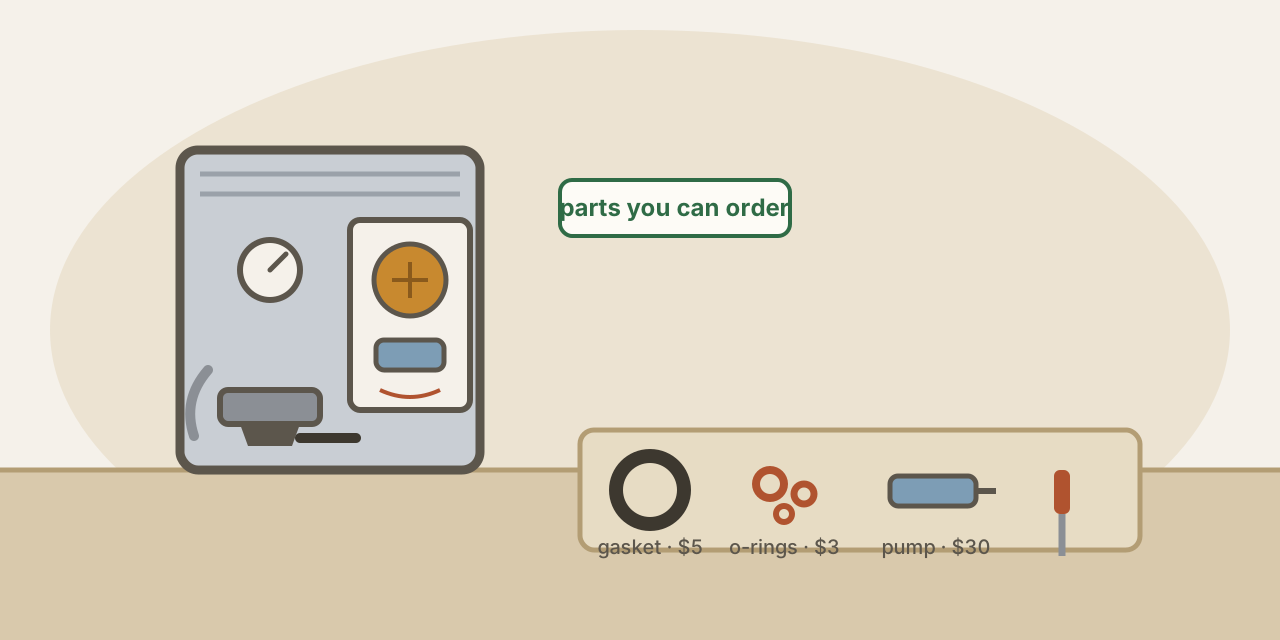
Espresso machines rarely die of big failures. They die of small parts you cannot buy. The components that actually fail — gaskets, o-rings, vibratory pumps, thermostats, solenoid valves, burr carriers — cost between $3 and $40 each. Whether your machine survives its first failure depends almost entirely on whether that part exists as an orderable item, and that is decided the day you choose the machine, not the day it breaks.
If repairability is the filter, the Gaggia Classic Evo Pro is the category's honest answer. It is built from parts that have been in continuous production for decades — standard gaskets, a commodity vibratory pump, a 58mm group with an entire aftermarket attached — and the same ecosystem that supports the mod ladder we've already mapped also means every wear part is a few dollars and a search away. A complete gasket and o-ring kit for it costs less than two café visits.
The machines that become paperweights share a pattern too: sealed proprietary assemblies, error codes only the manufacturer can clear, and wear parts with no part number. This cycle's community reports — a Eureka grinder dead over an unobtainable burr carrier, a brand-new Fellow bricked by a BOILER_FILL_ERROR — are that pattern in the wild.
And most "dead" machines were killed, not lost: scale and coffee-oil buildup cause a large share of the failures people replace machines over. A descale routine and a tub of backflush detergent are the cheapest reliability upgrades in espresso.

Three failures from this month, and what they teach
Every claim in this guide is a linked owner report or a published spec — BrewTested runs no reliability lab, and a survey like this is only honest if you can click through to the source. This month's r/espresso and r/Coffee threads handed us three perfect specimens.
The part with no part number. An owner stripped the lower burr carrier of a Eureka Mignon Specialita — a respected, mid-tier grinder — and then hit the wall: "Of course the lower burr carrier does not have a part number and it's impossible to find a replacement anywhere." Out of warranty, the manufacturer deferred to the reseller, and a several-hundred-dollar grinder now hangs on the availability of one machined component. The lesson is not that Eureka is bad — it is that *a part you cannot order is a countdown timer*, and no spec sheet lists which parts those are.
The error code only the maker can clear. A brand-new Fellow Espresso Series 1 died within days showing BOILER_FILL_ERROR with unresponsive brew buttons. A first-generation machine from a young company can be a fine product — but when the failure mode is a firmware error state rather than a worn gasket, there is nothing an owner *can* fix. You are not a customer with a screwdriver; you are a warranty claim in a queue.
The slow fade nobody diagnoses. A Philips LatteGo that froths oat milk normally but quit frothing dairy after 18 months is the subtlest of the three — a behavior change that looks like a broken machine but is usually chemistry and buildup, the same family of problem we unpacked in the steam wand troubleshooting guide. A meaningful share of "broken" machines are this: maintenance debt presenting as hardware failure.
And one counterweight, from the same week: an owner retired a Breville Barista Express after eight years of service. Machines in this category can go the distance — the question is what happens the first time one doesn't.
What actually wears out (it is the same short list on every machine)
Strip the branding off any sub-$2,000 espresso machine and the wear-parts list is remarkably consistent:
Rubber first. Group gaskets, o-rings, and seals live in a hot, wet, pressurized environment and harden on a 1-to-3-year cycle regardless of brand. A hardened group gasket announces itself as leaking around the portafilter — a $5 part and a ten-minute job *on machines where the part exists*. On the Gaggia platform you can buy the whole seal set as a kit and re-gasket the machine in an evening.
The pump second. Most home machines — Gaggia, Rancilio, and a long tail of others — use commodity vibratory pumps from the same small group of suppliers, which is why a replacement costs $20-40 almost universally. A failing one gets loud before it gets dead, so you usually get warning. Machines with custom-integrated pump assemblies convert this commodity repair into a proprietary one.
Heat control third. Thermostats, thermal fuses, and heating elements fail predictably with age and scale load. On open platforms these are numbered, documented parts with tutorials; on sealed thermoblock designs the same failure often totals the machine economically, because the block comes out as one expensive assembly — when it comes out at all.
Valves and flow paths, always. Solenoid valves stick and three-way valves clog — overwhelmingly from scale and coffee oils rather than defects, which is why the two-product prevention routine (backflush detergent for oils, a proper descale cadence for minerals) prevents more failures than any warranty ever pays out.
And on grinders: the burrs are fine, the carrier is the risk. Burrs themselves are standardized sizes and last for years of home use. What kills grinders is the fiddly machined bits around them — carriers, threads, adjustment collars — exactly the parts the Eureka thread found missing from the catalog.
The repairability spectrum, machine by machine
| Platform | Parts situation | What that means at failure #1 |
|---|---|---|
| Gaggia Classic Evo Pro | Decades of parts continuity, standard gaskets, commodity pump, huge aftermarket and mod community | Order the part, watch one tutorial, fix it tonight. The platform our whole mod ladder is built on. |
| Rancilio Silvia and E61-group machines | Same story at higher price points: standardized groups, documented internals, parts sold openly | Serviceable for decades; many examples outlive their owners' interest in espresso. |
| Breville (Barista Express family) | Mixed: gaskets, screens, and many consumables orderable; deeper assemblies proprietary but widely documented | Common wear items fixable — the problems guide covers the frequent ones; a deep internal failure out of warranty is often uneconomic. Eight-year service lives are reported. |
| Super-automatics (LatteGo and kin) | Brew-group consumables available; milk-path behavior problems dominate; internals sealed | Maintenance debt masquerades as failure — clean the milk path before mourning the machine. |
| First-generation app-era machines | Parts catalog thin to nonexistent; failures surface as error codes only the maker can address | You are betting on the company's support desk, not on your screwdriver. Fine inside warranty; a gamble after. |
What we would buy
Selected on parts availability, platform longevity, and the failure reports linked above. BrewTested has not bench-tested reliability and claims no failure-rate measurements of our own — the evidence here is linked owner reports and published parts catalogs, and the ASINs were verified as live listings the day this was published. Prices move constantly, so we do not quote them.
The repairable pickGaggia Classic Evo Pro
The machine this whole argument recommends: a 9-bar single-boiler built from parts with decades of continuity, a commercial-style 58mm portafilter, and an updated boiler Gaggia states better resists scale and corrosion. Nothing about it is exotic — which is precisely the feature. When the gasket hardens in year two you fix it for pocket change, and when you outgrow stock behavior, the mod ecosystem is already mapped. Listed at 9.5 x 8 x 14.2 inches, 20 lb, made in Italy.
Check price on Amazon The $15 rebuild
Gaggia Classic gasket & o-ring kit (Viton)
The proof of the ecosystem argument in one listing: a complete seal set — grouphead gasket, boiler o-rings, valve seals, stainless screws — for the Classic platform. Buy it before you need it; the day the portafilter starts weeping around the edges, you will have the machine back in service the same evening. This is what parts availability looks like when a platform takes it seriously.
Check price on Amazon Prevention, not cure
Urnex Cafiza espresso machine cleaning powder
The unglamorous half of repairability is not needing the repair. Coffee oils gum three-way valves and shower screens long before anything actually breaks, and a weekly backflush (on solenoid machines) or screen-and-basket soak dissolves the buildup for cents per week. Paired with a sane descaling cadence, this is the routine that keeps the wear list at gaskets-only. 566-gram tub; a little goes a long way.
Check price on AmazonBefore you declare any machine dead, run the maintenance-debt checklist: descale (minerals choke flow and heat), backflush or soak the screen and basket (oils change extraction and stick valves), and clean the milk path end to end (protein residue changes frothing behavior long before hardware fails). A meaningful share of "broken" espresso machines in this month's threads — the LatteGo above included — are chemistry problems wearing a hardware costume. The checklist costs twenty minutes and is free; the replacement machine is not.
Frequently Asked Questions
Is a repairable machine actually cheaper over ten years?
Usually, and by more than the sticker math suggests. A serviceable single-boiler plus $30-60 of parts across a decade beats replacing a sealed machine once, and it is not close. The honest caveat is labor: repairable machines assume you will spend the occasional evening with a screwdriver and a tutorial. If you know you never will, a machine with a strong warranty and a responsive support desk is the truer fit — just price in that year six looks very different on the two paths.
How do I check parts availability before buying a machine?
Search the machine's name plus "group gasket," "pump replacement," and "parts diagram" before you buy. A healthy platform surfaces numbered parts, exploded diagrams, and multiple sellers immediately. Thin results — or parts sold only through one official channel — is the warning. For grinders, search the model plus "burr carrier" specifically; as this month's Eureka thread shows, that is the part that decides whether a stripped thread is a $20 fix or a dead grinder.
Are Breville machines repairable?
Partially, and it is fair to say so rather than rounding either way. Consumables and common wear items — gaskets, screens, steam tips, o-rings — are orderable, and the frequent failure modes are well documented. Deeper assemblies are proprietary, and an out-of-warranty internal failure is often uneconomic to fix. In practice owners get respectable lifespans — the eight-year Barista Express retirement linked above is a real data point — but the platform rewards maintenance discipline more than wrench skills.
What is the single most preventable espresso machine failure?
Scale. Hard water deposits choke boilers, stick solenoid valves, and kill heating elements, and it is entirely a function of your water and your descaling cadence — our descaling guide covers how often for your water hardness. Second place goes to coffee-oil buildup, which is what backflushing exists for. Between them they account for a large share of the machines people replace, which is why the cheapest reliability upgrade in espresso is a $15 jug of the right chemicals used on schedule.
Should repairability change which machine I buy at $600?
It should at least get a vote. At that budget you are typically choosing between an all-in-one with more conveniences and a simpler machine on an open platform — the same fork our budget-split guide frames for other reasons. The all-in-one wins on day one; the open platform wins on year five. If you keep machines a long time, weight the parts shelf heavily. If you upgrade every couple of years anyway, repairability matters less than resale — though the machines that hold value best tend, not coincidentally, to be the repairable ones.
Where this fits
Repairability is one input, not the whole purchase. How to weigh it against grinder quality and workflow is the job of how to split your espresso budget, and if you are cross-shopping the Breville family specifically, the Express-versus-Impress comparison carries the eight-year durability report in context. If your machine is misbehaving right now, start cheaper than replacement: the Barista Express problems guide and the steam wand troubleshooting page both exist because most "broken" machines aren't.
The short version: the wear list is the same everywhere — rubber, pump, heat, valves. Buy the machine where those four things have part numbers, keep the scale and oils out, and your espresso budget goes into coffee instead of replacements.