Barista Express vs Barista Express Impress: What the Extra Money Actually Buys
Same boiler, same 54mm portafilter, same built-in grinder lineage, and one of them tamps for you. Whether the Impress's assisted puck prep is worth the price gap depends on exactly one thing: who is going to be pulling the shots.
Some links below are affiliate links. If you buy through them, BrewTested may earn a small commission at no extra cost to you. We only recommend gear that passes our Fit Analysis, and we publish the ones that don't.
The Impress is the Barista Express with the hardest beginner skill (dosing and tamping) turned into a lever pull. Underneath, the espresso-making machinery is the same family: thermocoil heating, 54mm portafilter, built-in conical burr grinder, 9-bar extraction.
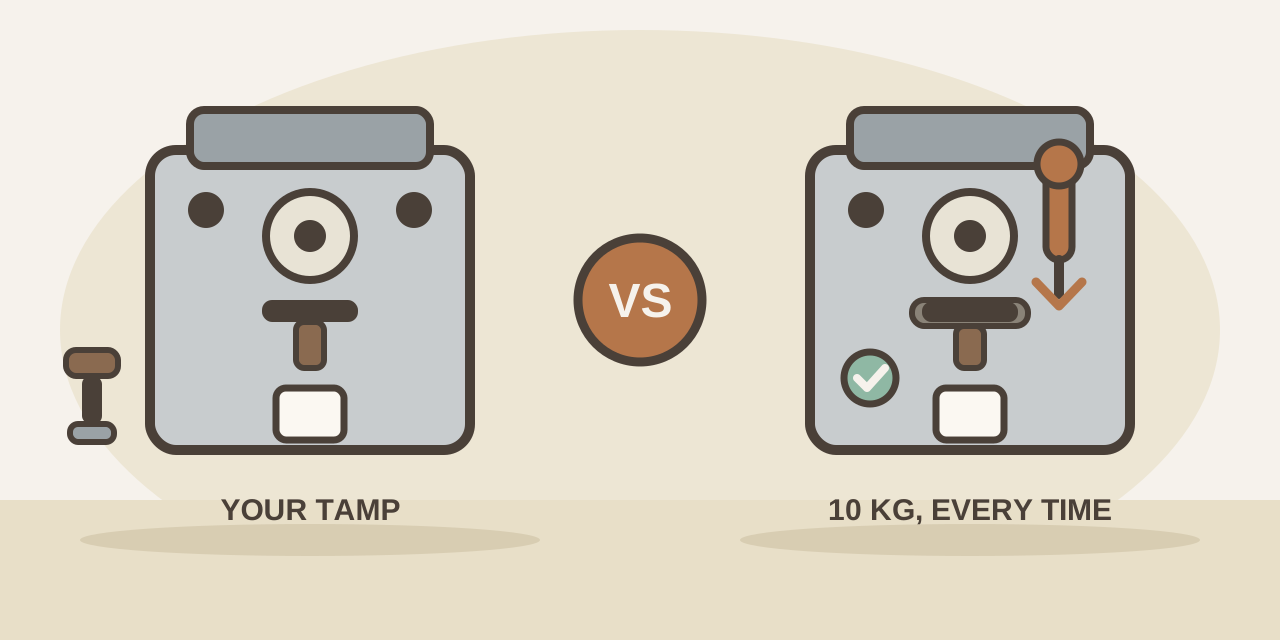
- Buy the Barista Express Impress if the machine will be used by a beginner, shared by a household, or judged by its worst shot rather than its best. The Impress puck system doses, tamps with a consistent 10kg press and a 7° finishing twist, and tells you how to correct the next dose. That eliminates the two variables responsible for most bad home espresso.
- Buy the Barista Express if one person owns the routine and wants to learn the craft, you will be tamping by hand within a month anyway, the shots can be identical, and the saved money buys a lot of coffee. It remains the machine we reviewed as the default all-in-one for a reason.
- The honest third option at this budget is skipping the all-in-one: a Bambino Plus plus a standalone grinder, the split-budget path from our budget guide that upgrades better later.
One asker in this week's r/Coffee thread put the real question plainly: coming from a Nespresso with $600 to spend and "so many mixed reviews." The mixed reviews are two different audiences reviewing two different purchases. Sorting yourself into the right audience is this page.

What is actually identical, because the marketing won't tell you
Strip the puck system away and the two machines are siblings from the same platform: a thermocoil heater with PID temperature control, a 54mm portafilter, a built-in conical burr grinder feeding it, pre-infusion followed by 9-bar extraction, and a manual steam wand fed by the same boiler, which means the same one-thing-at-a-time workflow: you pull, then you steam. Neither machine changes what a well-prepared shot can taste like. Cup ceiling: identical.
The practical differences that are *not* the puck system, quickly: the Impress carries 25 grind settings against the Express's 16, more useful resolution for dialing in, since the jump between adjacent settings on the 870 can overshoot the sweet spot. The Impress's grinding happens into a cradle that holds the portafilter for you rather than your hand holding it under the chute. And the Impress is slightly larger and heavier (listed at 14.5 x 12.5 x 16.5 inches and 23.7 lb against the Express's 13.8 x 12.5 x 15.9 and 22.1 lb) worth checking against your under-cabinet clearance, since both need top access for the bean hopper and water tank.
Everything else you have read about the Express applies to both, including the known problems and their fixes and the steam wand diagnostic, which share most parts across the platform. Durability data transfers too: the Express has been sold largely unchanged since 2013, and this week an owner retired one after eight years of service, not a guarantee, but the best long-service evidence any machine in this bracket has, and the Impress inherits most of that platform.
What the Impress puck system actually automates, and why that matters more for some buyers
Espresso has roughly four variables a beginner can ruin: dose (how much coffee), distribution (how evenly it sits), tamp (how hard and how level it is pressed), and grind size. A barista learns to control all four; the learning happens through weeks of sour, bitter and channeled shots. Our sour vs bitter diagnostic exists because of exactly that learning curve.
The Impress removes two and a half of the four. Its dosing system measures the grind into the portafilter and (the clever part) tells you after tamping whether the dose was high or low, then auto-corrects the next one. Its tamping lever applies a consistent 10kg press, dead level every time, with the 7° rotation a barista's wrist adds to polish the puck. What is left for the human is grind size (which the machine's readout helps you converge on) and taste.
Who that matters for is the entire decision. A single owner who watches technique videos will replicate a 10kg level tamp by hand within a few weeks, at which point they have paid the premium for a convenience they no longer need, that buyer should buy the Express and spend the difference on beans (or on nothing). But a machine shared between two people, or used by someone who wants coffee rather than a hobby, is judged by its *worst* shot of the week. The Impress raises the floor, not the ceiling. Households where one person dials in and another 'just makes a coffee' are exactly where the Express's flexibility becomes inconsistency, and exactly where the Impress premium earns itself daily.
The honest costs: the premium itself (typically a couple hundred dollars street, though both machines discount often), a slightly slower worst-case workflow when the auto-dose needs correcting, and one more mechanical system that can eventually need service on a machine you plan to keep for eight years.
The two machines, and the split-budget alternative
| Barista Express (BES870) | Express Impress (BES876) | Bambino Plus + grinder | |
|---|---|---|---|
| Dose & tamp | Manual: your skill, your variance | Assisted: measured dose, 10kg tamp, 7° twist, correction readout | Manual, plus buying a separate tamper |
| Grind settings | 16 | 25 | Grinder-dependent: 40 on the Encore ESP |
| Steam | Manual wand, same boiler | Manual wand, same boiler | Auto or manual milk on the Bambino Plus |
| Learning curve | Steepest, and that is its appeal to hobbyists | Shallowest path to consistent shots | Middle; grinder dialing is on you |
| Upgrade path | Replace the whole machine | Replace the whole machine | Upgrade machine and grinder separately: the argument of our budget-split guide |
| Footprint (listed) | 13.8 x 12.5 x 15.9 in, 22.1 lb | 14.5 x 12.5 x 16.5 in, 23.7 lb | Two small footprints, more total counter |
| Best for | One owner, wants the craft | Shared kitchens, beginners, consistency-first buyers | Anyone who will upgrade within 3 years |
The Nespresso upgrader's actual answer
The thread that prompted this page deserves a direct reply, because the asker's situation (Nespresso owner, $600, "not sure if I will want to weigh the beans") is the single most common profile arriving at this decision.
That last clause is the tell. Not wanting to weigh beans, keep a routine, or watch tutorials is a legitimate preference, and it points cleanly at the Impress: its whole design premise is delivering real-espresso results without the ritual. At street prices the Impress regularly sits near that budget, and the leap from capsule coffee will be immediate either way, fresh-ground espresso from either machine is a different beverage from a Nespresso pour.
The one warning both machines deserve: an all-in-one is a marriage. The built-in grinder cannot be upgraded separately, and when you outgrow the machine (our budget guide explains why the grinder is usually what you outgrow) the whole unit goes. Buyers who already suspect this hobby will escalate should read grinder first or machine first before committing to either Breville; everyone else should ignore that rabbit hole and enjoy the machine.
The machines
Selected on manufacturer specifications and the platform's long service record; BrewTested has not bench-tested the Impress puck system, tamp force and dose-correction behavior are Breville's published claims. Dimensions are Amazon product data. Prices move constantly and both machines discount often, so we do not quote them.
Consistency pickBreville Barista Express Impress (BES876BSS)
The Express platform with dosing and tamping automated: measured dose with next-shot correction, 10kg level tamp with the 7° finishing twist, 25 grind settings, portafilter cradle. Listed at 14.5 x 12.5 x 16.5 inches and 23.7 lb, brushed stainless. Other colorways carry separate listings.
Check price on Amazon The known quantity
Breville Barista Express (BES870XL)
Sold largely unchanged since 2013, which is its own review: parts, fixes and technique videos exist for everything that can go wrong, and this week's threads include one retired after eight years of daily service. Manual dose and tamp, 16 grind settings. Listed at 13.8 x 12.5 x 15.9 inches and 22.1 lb. Our full review covers it in depth.
Check price on Amazon The split path
Bambino Plus (BES500) + Baratza Encore ESP
The alternative both Breville listings hope you don't consider: a compact machine with auto milk (listed 12.5 x 7.6 x 12.2 in, 11 lb) beside a dedicated 40-setting espresso grinder (13.4 in tall, 5.6 lb) that survives every future machine upgrade. Slightly more total counter space and effort; meaningfully better upgrade economics.
Check the Bambino Plus on AmazonWhichever you choose, the first-week experience is decided by water and beans, not the machine. Use filtered water from day one (scale is the platform's long-term enemy, and our descaling schedule guide covers the cadence) and buy beans roasted within the past month from a roaster, not the supermarket aisle. A $700 machine fed stale beans makes convincing proof that you wasted $700. The machine is the third most important purchase of the three.
Express vs Impress: FAQ
Do the Express and Impress make the same quality espresso?
At their best, yes: the heating, pressure, portafilter and grinder lineage are the same family, so a dialed-in shot from either is equivalent. The difference is the distribution of your shots between best and worst. Manual prep on the Express means your variance; the Impress compresses that variance mechanically. Buyers comparing them on peak quality are comparing the wrong number.
Is the Impress worth it for an experienced home barista?
Mostly no. If you already dose by weight and tamp level, the Impress automates skills you own, and its cradle workflow is arguably slower than your routine. The exceptions: shared machines where the other users don't have your habits, and anyone whose wrists object to tamping, the lever is genuinely easier on repetitive strain.
Should I buy the Barista Pro instead?
The Barista Pro swaps the Express's thermocoil for the faster-heating ThermoJet and an LCD, but keeps fully manual dosing and tamping, it answers 'I want shorter warm-up,' not 'I want consistent pucks.' Between Pro and Impress, decide which problem you actually have. Coming from capsules with no technique, the Impress solves the more common one.
What breaks on these machines, and can I get parts?
The platform's decade of ubiquity is the reassurance: grinder impellers, solenoids, steam-wand tips, seals and o-rings are all documented, available, and mostly DIY-serviceable, our Barista Express problems guide walks the common ones. The Impress adds its dosing/tamping mechanism, which is newer and less field-documented; it inherits the rest. Descale on schedule and use filtered water and either machine's realistic service life runs many years, this week's eight-year retirement thread is the existence proof.
I'll outgrow an all-in-one eventually. Does that mean I shouldn't buy one?
Not necessarily: 'eventually' doing a lot of work in that sentence. If you honestly expect to chase better shots within a couple of years, the split path upgrades piecewise and wastes nothing. If espresso is a beverage rather than a hobby, an all-in-one you keep for six-plus years is the better ownership experience: one box, one workflow, one warranty. The mistake is only buying the all-in-one while planning to outgrow it.
Related reading
The full Barista Express review is the deep dive on the shared platform, and the three-way against the Bambino and Gaggia Classic Pro is where the Express earns its default status. If the split path tempts you, how to split your espresso budget makes the full argument, and grinder first or machine first settles the order. Once either machine lands: the sour vs bitter diagnostic for dialing in, and the descaling schedule for keeping it alive past that eight-year benchmark.